Tuesday, 14 September 2021

Voice to Cart: The Game Changer for E-commerce in India


We have 628 million smartphones, 450 million Paytm users but only 130 million active users. We have over 2.8 billion UPI transactions, but how many of them are for e-commerce? There are only 88 million e-commerce customers.  Only 4 out of 10 installs will get a customer who buys anything. 

This is because most people in India are not comfortable using e-commerce apps due to their UI complexity. So, if e-commerce is a key channel for sales for any brand, there is a gigantic customer base that is not being addressed today. 

Voice is to this decade, what mobile apps were to the previous decade - the biggest growth explosion lever for e-commerce companies to acquire 400 million new customers in India alone. 

It’s no surprise that many prominent e-commerce players like Amazon, Flipkart, and Jio have started experimenting with it by adding their home-grown in-app voice assistants. Similarly, companies like Big Basket, Udaan, and P&G are working with some cutting-edge startups to add in-app voice assistants to their own apps. So, let’s see what the top use cases are being powered by voice assistants in popular e-commerce apps.

Multilingual Voice Search

Search is the most widely used feature in any e-commerce application, but it also acts as a major drop-off point in a consumer’s purchase path while they discover new items. Here are the most common reasons customers drop off during search –
- Typing  - Typing is painful, especially on a smartphone keyboard; requires English spelling mastery, and typing vernacular words in English is fuzzy in spellings (aalu, aloo).
- English -  People generally think of items in their native language and try to type them out, but the SKUs are usually indexed with the English version of the word.

Typing is a hurdle, especially with non-English languages.
- Spelling Challenges - Spelling out complicated terms is tough.
- Product Discovery - Auto suggestions are great, but they limit the customer to popular items and prevent the discovery of newer or less frequently purchased items.
- Synonyms  -  People might not always know the exact item they want and might use a word with a similar meaning (‘low-fat’ > ‘skim’)
- Filters - It’s natural to apply filters in search, but currently, most apps expect filters to be an explicit UI operation. Customers have to engage in two separate activities to get the result they want (*'blue jeans under Rs 2,000'*)

Voice-powered search eliminates most of these issues and also makes repetitive voice search for even power users much faster - by up to 33 percent - compared to usual touch and type interfaces.

Voice to Cart in a Single Step!

Voice enables people to complete their tasks on apps much faster by letting them speak a single command which otherwise would have been a multi-step process. 

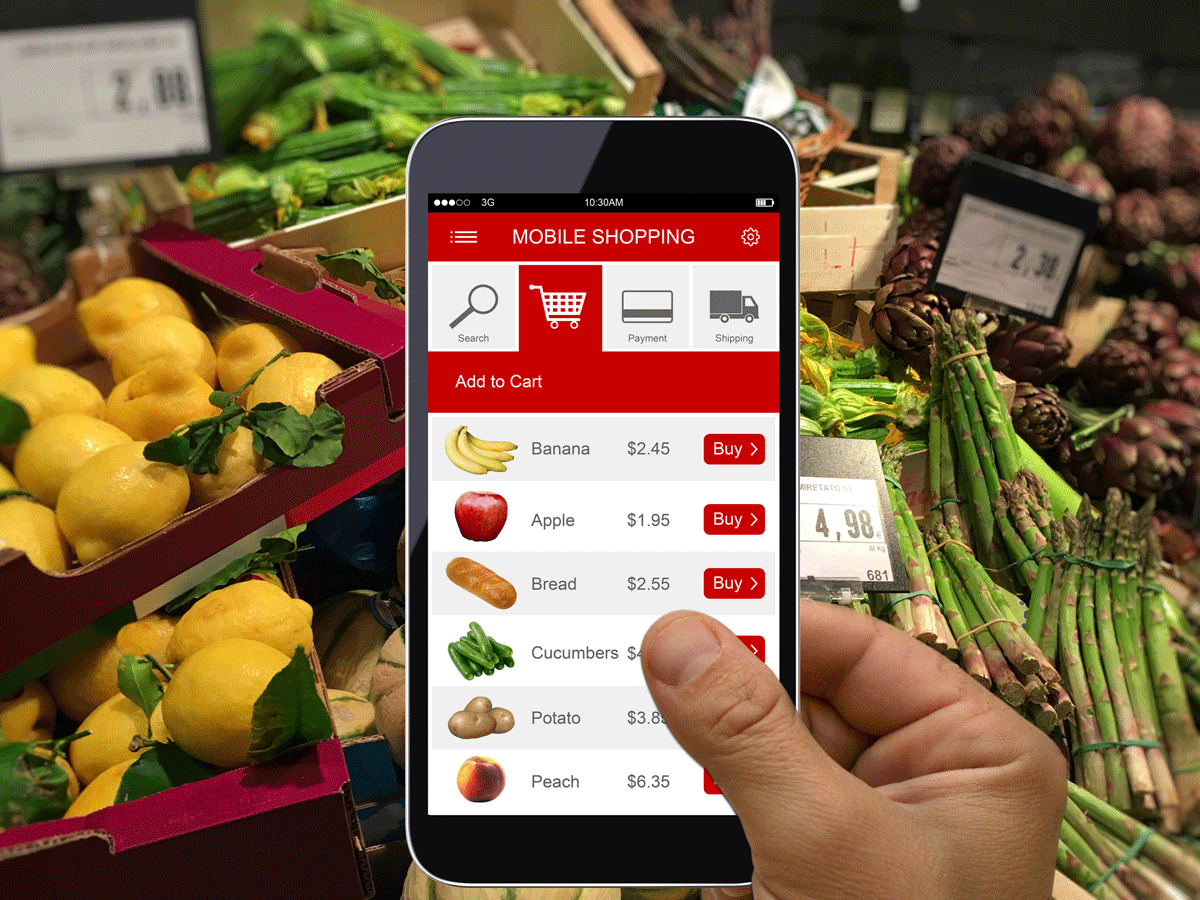
For example: ‘Add 2 kgs of Aashirvaad aata’ (In this case, it’s now possible to identify the actual SKU and the quantity and add it to the cart directly). 

The ability to do this entire action in one command is 3X faster than manually adding each item. Now, imagine building a monthly grocery list of 40 items in a grocery shopping app!

Voice Promotions

Voice promotions are just-in-time voice nudges that contextually inform the shopper about the availability of offers (‘There is an offer for buy 2 get 1 free. Would you like to buy 2 items instead?’), and then follow up with an explicit yes or no question. This, again, very closely mimics the real-world shopping experience, where the person manning the checkout counter has the best influence to push an offer (‘Ma’am, you could buy 3 of these at 20 percent off?’).

Voice Navigation

Consumers coming online for the first time have a bigger difficulty. This complexity creates a lot of cognitive overload on these first-time consumers causing drop-offs and a reduction in conversion. A person trying to find the delivery status or invoice for purchase will have to perform 4-5 actions minimum - whereas a simple voice command like ‘delivery status’ is 3X-4X faster than touch and type!

Voice Navigation allows consumers to be in control and just speak out what their intent is – ‘fruits and vegetables’, ‘track my order’, ‘show my cart’ or ‘what offers do I have on my credit cards?’ The app then can quickly take them to their destination without them having to figure how to get to that screen themselves.

Hands-free Shopping, Building Shopping Lists, Voice Feedback, and More

There are lots of new capabilities that voice shopping enables that are otherwise not possible. The ability to use the app without having to interact with it constantly (hands-free shopping) or the ability to quickly blurt out their shopping list (list to cart) or the ability to collect better quality feedback by allowing customers to share their experiences by just talking to the app. All these make the app a lot easier and faster to use for your customers - irrespective of their comfort with apps.

In-App Voice Commerce Journey is Just Beginning

There are 1,000X more smartphones in the world than there are smart speakers in homes. That automatically makes the APP the king of all channels to engage and entice your customers to shop with retail brands on a consistent basis. So, making apps faster and more accessible to millions of consumers will only help brands grow their customer base and retention rates rapidly.


Thursday, 23 April 2020

IAMAI requests government to fully open e-commerce

IAMAI requests government to fully open e-commerceNEW DELHI: The Internet and Mobile Association of India (IAMAI) on Monday requested the government to open up e-commerce services amid the coronavirus lockdown.

The Centre, in its order on April 15, had said e-commerce platforms would be allowed to sell non-essential items from April 20. However, on April 19, the government reversed its order and prohibited e-commerce platforms from selling non-essential items during the lockdown.

Responding to the last minute announcement made by the ministry of home affairs, the IAMAI urged the government to reconsider its decision.

"IAMAI believes that the debate of online vs offline is an incorrect portrayal of the ground reality. There are lakhs of sellers from the physical markets across India who also sell online. In fact it is these medium & small offline enterprises that are powering the online e-commerce in a significant way," the association said in a statement.

"Resumption of one part of their business will help them with liquidity and will lead to larger restoration of demand,"it said, adding, "Besides, thousands of Kiranas are now leveraging E-commerce and its proven and safe supply chain for delivery to consumers. Today the only priority is to emphasize on 'Social Distancing' and e-commerce can support India's fight against Covid-19."

The IAMAI statement said that after nearly a month of lockdown, the debate is not necessarily between what is 'essential' and what is 'non-essential' but the real debate is how not to choke demand completely when the country is going through a health crisis.

"The key to "returning to normal" is the fulfilment of consumer demand which under the present public health crisis can be effectively done through e-commerce," it maintained.

"IAMAI, therefore, strongly suggests that whatever can be delivered to the customer safely keeping in mind the health crisis, should be allowed immediately," the statement said.

Subho Ray, president IAMAI, said: "Preservation of consumer demand is of prime importance that will keep the economy chugging along as the country starts the difficult process of economic recovery. This demand needs to be met and nurtured towards restoration rather than being suppressed to a future date. Online commerce is a safe and ready choice that is open to all sellers, including those who continue to see it is a threat. Lakhs of small sellers have embraced online channels and are today equipped to serve the country. Allowing full operations of e-commerce is the first step towards economic revival - one that helps buyers, but more importantly helps small businesses stay alive and start building towards a recovery."

Top Amazon vendor Cloudtail delays payments to suppliers

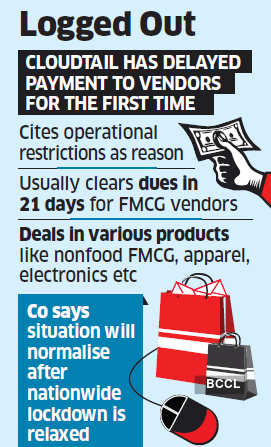
Top Amazon vendor Cloudtail delays payments to suppliersNew Delhi: Cloudtail India, one of the largest sellers on Amazon’s India marketplace, is delaying payments to brands and suppliers because the Covid-19 outbreak and the ensuing lockdown have hit business. Amazon is a minority stakeholder in the company.

“Governmental restrictions given the Covid-19 outbreak and the advisory to sell only essential products have impacted our supply chain and restricted our operations,” Cloudtail said in an email to one of its large vendors that ET has seen. “In view of the same, please expect a delay in processing of your payment.”

Cloudtail said it’s working with stakeholders to ensure that the disruption is minimised. “We are actively working with vendors, employees, marketplaces, banks and regulators to get through these testing times,” a Cloudtail spokesperson said in an email to ET.

Top Amazon vendor Cloudtail delays payments to suppliers
‘In Constant Touch with Vendors’
“We are in constant touch and are actively working with them to sort out the issues they face in respect of payments after the lockdown.”

Cloudtail hasn’t made payments since March 23, according to various executives at large fast-moving consumer goods (FMCG) vendors and companies. They include an official at an FMCG multinational who directly handles the ecommerce accounts of various platforms, including Amazon and Flipkart. Cloudtail is generally not known to delay payments, said the people cited above.

“This is an unprecedented crisis which has disrupted the lives of people and businesses at a very large scale,” Cloudtail told ET. “We understand and deeply empathise with the challenges faced by our vendor partners during this difficult period, due to this extraordinary, uncontrollable event that all of us are experiencing.”

The Centre has restricted ecommerce companies to home deliveries of essential goods, forbidding them from selling so-called non-essentials. That has hit many sellers of items ranging from apparel to electronic goods such as Cloudtail, which is saddled with a large inventory of such goods, said the people cited above.

“We expect the situation to normalise when the nationwide lockdown is relaxed and we resume regular operations,” Cloudtail said in its email to vendors.

Cloudtail is owned by Prione Business Services, a joint venture between Infosys founder NR Narayana Murthy’s Catamaran Ventures, which has a 76% stake, and Amazon, which holds 24%. It posted revenue growth of 25% to Rs 8,945 crore and a profit of Rs 29.4 crore in FY19, according to regulatory filings.

Cloudtail was in the news in 2018 after India amended its foreign direct investment rules for ecommerce marketplace and the joint venture had to change its shareholding structure to stay compliant with the changed norms. Amazon reduced its stake in Prione from 49% to 24% in February 2019 as part of this exercise.

E-grocers like BigBasket, Grofers , others surge ahead on deliveries

E-grocers like BigBasket, Grofers , others surge ahead on deliveriesBENGALURU: BigBasket and Grofers, India’s biggest online grocers, have nearly doubled the number of daily deliveries compared with a month ago, as more consumers hit the internet to buy essentials amid the ongoing lockdown.

The surge has come despite shuttered warehouses in the early days of the lockdown that began on March 25 to stem the spread of the Covid-19 virus outbreak.

Elevated Demand
Supply and labour shortage also put a spanner in the works initially, reducing operating capacity to onetenth at these grocery etailers.

The teething troubles now seem to be over, although elevated demand will mean consumers shopping online for groceries will still have to wait for delivery slots.

Despite the bottlenecks, BigBasket said 283,000 orders a day are being met, up from 150,000 before the shutdown, while Grofers said it was servicing 190,000 daily orders against 100,000 before the crisis.

“Today, we deliver 2.83 lakh orders and are growing. Sadly, the expectation is three to six times this number... We are really trying our best,” Hari Menon, BigBasket's cofounder, wrote on microblogging platform Twitter on Monday.

Since many workers left for their hometowns just before the lockdown, planning and operations were disrupted, he said. “That was something we didn’t anticipate, which meant we couldn’t pick orders and deliver them in sufficient numbers to satisfy the 3-6X increase in demand,” Menon said.

BigBasket’s main rival Grofers said it has faced an unprecedented surge in demand during the lockdown. “After the initial hiccup in operations, we were able to scale up rapidly and have now served over 25 lakh households across 24 cities. Today, we are serving over 1.9 lakh orders a day and projecting this to increase by 50% in the coming month,” said Albinder Dhindsa, cofounder, Grofers.

It is ramping up supplies from brands and manufacturing partners to meet demand, he added. Both BigBasket and Grofers are also expected to hire big in the coming weeks. While BigBasket will take on board 10,000 new workers, Grofers will hire 4,500 workers in the next two weeks after having added 2,500 already, ET reported earlier.

Horizontal Thrust
Horizontal marketplaces Flipkart and Amazon have also muscled into the online grocery space. Walmart-owned Flipkart has scaled up delivery of groceries to nearly 400 cities from five cities prior to the lockdown, a company executive told ET.

The Food Safety and Standards Authority of India (FSSAI) had given provisional approvals to stock packaged food items at its 125-odd warehouses and the company is now delivering more grocery orders than before, the executive said.

Amazon, which has had a headstart over Flipkart in the groceries category, stopped accepting orders for its Pantry services across 100 cities, leading to a backlash from consumers. However, the situation has improved, it said.

The company said Pantry is up and running in 85 cities now, while its two-hour delivery service Fresh is operational in the six cities it is present in. “In the last one week, we have added more than 60 cities that get essential products through Amazon Pantry, taking the total number of cities to over 85,” Amazon said in a statement. “Customer demand in all these cities is more than 2x pre-lockdown...”

Social commerce startup Meesho, etailers Paytm Mall, Shopclues and Snapdeal, and real-estate firms such as NoBroker have also diversified into the grocery space, ET reported on April 9. Food-delivery apps Zomato and Swiggy, too, have doubled down on the grocery category since it began seeing an uptick in demand. While Swiggy was already present in the grocery delivery segment, Zomato tied up with Grofers to launch the services.

'Cash on delivery' orders likely to go down post Covid

'Cash on delivery' orders likely to go down post CovidNew Delhi : The number of cash-on-delivery orders is likely to go down as the coronavirus crisis subsides, according to a poll of senior e-commerce industry professionals done by ClickPost.

Around 76 per cent of professionals said that the share of cash-on-delivery orders will go down post-Covid. Further, most of the professionals were of the view that the number QR code based transactions would increase.

The poll also showed that 81 per cent of respondents said that share of e-commerce in India's retail market will increase, driven by both increases in e-commerce sales and decrease in offline sales.

Further, in an online conference hosted recently by ClickPost on the short to medium term impact of COVID-19 on e-commerce, sector players said that that brands should first focus on clearing their inventory as the nationwide lockdown is lifted or the relaxed.

The industry players were also of the view that companies should focus on conserving cash and driving repeat purchase which is usually cheaper than new customer acquisition.