Thursday, 30 November 2017

Amazon India Reports Over 105% Revenue Growth In FY17

At a time when Flipkart’s valuation has been marked up by one of its investors Morgan Stanley, the Indian arm of global ecommerce behemoth Amazon has reported over 105% growth in revenue in FY17.
As per filings with the Registrar of Companies (RoC), Amazon Seller Services posted a 41% increase in earning to $485.4 Mn (INR 3,128 Cr) during the said period. Amazon Seller Services currently earns through commissions, advertisements and shipping fees.
Recently, in the third week of November, Amazon India issued paid-up capital of $2.7 Bn (INR 17,839 Cr) towards its marketplace arm Amazon Seller Services, as per its regulatory filings.
Commenting on the feat, a spokesperson for Amazon said, “Comparing like-to-like, the Amazon Marketplace revenue in India grew by 105% for the year ending March 31, 2017. The Annual Returns filings include other line items.”
In addition to earnings from the marketplace and seller commissions, Amazon India currently generates revenue from its Seattle-headquartered parent by way of advertising fees, royalty on sales of Amazon’s in-house brands like Kindle and other transactions.
As per industry experts, the ecommerce giant’s impressive growth can be attributed, in part, to demonetisation which was instituted in November 2016. Speaking on the matter, an online seller on Amazon requesting anonymity said, “Last fiscal, the impact on Amazon was across categories -smartphones to electronics to apparel. These are the largest selling and fastest growing segments in e-commerce.”
According to some, however, Amazon’s growth in sales slowed down considerably after the Indian government’s Department of Industrial Policy and Promotion (DIPP) cautioned online marketplaces against deep discounting in April 2016.
A report by Hong Kong-based Counterpoint Research, for instance, states that the online sales of smartphones and other gadgets stagnated last fiscal after a three-year period of steady growth. Online smartphone sales increase merely by one percent to 32% in 2016, which the study ascribed to demonetisation, lower discounts and uniform pricing across online and offline platforms.
Another factor that has contributed to the slowdown pertains to the new FDI guidelines issued by the DIPP last year. Formalised in March 2016, the stricter guidelines on ecommerce dictate:
  • An ecommerce entity would not permit more than 25% of the sales effected through its marketplace from one vendor or their group companies.
  • Ecommerce entities providing marketplace would not directly or indirectly influence the sale price of goods or services and shall maintain level playing field.
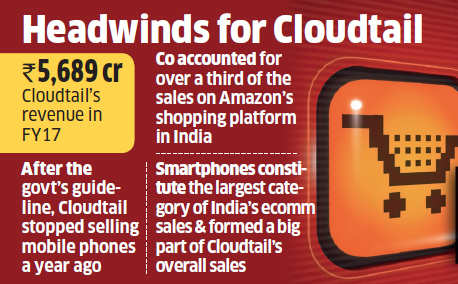
Consequently, Amazon India’s biggest seller Cloudtail stopped the sale of mobile phones on its platform in September 2016. Prior to that, smartphones contributed towards a significant portion of Cloudtail’s revenues. As per the earning report posted recently, Cloudtail recorded a 24% jump in its revenue for FY17, showcasing a net revenue of $883.1 Mn (INR 5,688.7 Cr).
However, this is significantly less compared to the 300% surge to $712 Mn (INR 4,586.9 Cr) the vendor reported in FY16. Cloudtail currently competes with Flipkart’s biggest vendor WS Retail, which posted a net revenue of $2.16 Bn ( INR 13,921 Cr) in 2016. The financial report for FY17 has not yet been filed by Flipkart.
Most recently, with the implementation of Goods and Services Tax (GST) in April 2017, Amazon India also had to suspend its invite-only Platinum Seller Program (PSP).
While changing regulations are making it more difficult for ecommerce platforms to sustain business growth, Amazon remains focussed on its aim to capture the Indian market. To that end, the online marketplace recently doubled its authorized capital to $4.74 Bn (INR 31,000 Cr), matching its earlier capital commitment of $5 Bn made in June last year. With the goal of getting ahead of rival Flipkart, the company is also doubling down on its efforts to diversify its business.  On the one hand, it is getting ready to enter the online food retail and grocery market, while on the other hand, it is eyeing a piece of the Indian digital payments pie with Amazon Pay. The strategy seems to be working, given that it clocked over 105% growth in FY17.

Wednesday, 29 November 2017

Strict FDI rules take a toll on Amazon’s largest seller Cloudtail

Amazon India’s largest seller Cloudtail crossed the Rs 5,000 crore sales mark in the year to March but growth tapered off significantly, indicating its fading role as the company seeks to comply with foreign direct investment (FDI) rules on marketplaces.

The government said last year that it will not permit a single vendor to account for more than 25% of sales on an online marketplace that has overseas investment.

Cloudtail, a joint venture between Amazon Asia and Infosys founder Narayan Murthy’s personal investment vehicle Catamaran, posted over a 24% jump in revenue to Rs 5,688.7 crore in FY17, according to its annual return. 

That’s against a 300% surge to Rs 4,586.9 crore in the previous year when it accounted for over a third of the sales on Amazon's shopping platform in India. 

Strict FDI rules take a toll on Amazon’s largest seller Cloudtail

“With the restriction, it was very clear that growth had to be moderated. But Amazon would still prefer to channel their goods through a seller where they can control margins and inventory,” said Devangshu Datta, CEO, Third Eyesight, a consultancy firm. Amazon India declined to comment. Cloudtail didn’t respond to an email. 

Cloudtail's numbers pale in comparison with Flipkart's biggest seller WS Retail, which posted sales of Rs 13,921 crore for the year ended March 2016. It hasn't filed a financial performance report for the last fiscal yet but Flipkart has also been reducing its dependence on the seller, in which its founders used to own a stake.

After the government's guideline, which ecommerce companies had to comply with by March 31, 2017, Cloudtail almost stopped selling mobile phones a year ago but continued with Amazon private labels in India. Smartphones constitute the largest category of India’s ecommerce sales and formed a big part of Cloudtail’s overall sales in previous years.

“With the smaller pace of growth by exiting smartphones, Cloudtail will surely comply with the FDI norms of one seller accounting for 25% of total transactions at Amazon last fiscal itself,” an executive said.

Another seller said Cloudtail’s gaze is on consumables such as FMCG, nutrition, apparel and televisions, which are the next focus areas for Amazon. Personal care, baby care and nutrition are also of interest. It currently sells Amazon exclusive television brands like TCL, Sanyo an .. 

Tuesday, 28 November 2017

India for status quo on e-commerce negotiations at WTO

India has expressed its “deep disappointment” over the US’ refusal to discuss issues related to food security.
In a move that formally counters efforts by members such as the EU, Japan, and Canada to push negotiations on e-commerce at the World Trade Organisation’s ministerial meet in Buenos Aires, India has circulated a draft ministerial decision stating that work should continue as per the current work programme based on “existing mandate and guidelines’’.
“India decided to be pro-active by circulating its own draft on e-commerce ensuring no changes in the current structure of discussions. This was needed to counter several developed members, including the EU and China, that are trying to move beyond the existing work programme and setting the tone for commencing negotiations,” a government official told BusinessLine.
Last month, a group of countries, which included the EU, Canada, Australia, Chile, South Korea and Paraguay, circulated a draft declaration seeking to establish a working party at the Buenos Aires meet and authorising it to conduct preparations for and carry out negotiations on trade-related aspects of electronic commerce on the basis of proposal by members.
“There is no way we can allow negotiations on e-commerce rules to begin at the WTO. It could be disastrous for our country as it could lead to goods coming in without duties through online trade. We want status-quo on e-commerce and that is what we have sought,” the official said.
The eleventh Ministerial Conference of the WTO in Buenos Aires from December 10 to 13 will be attended by Commerce and Industry Minister Suresh Prabhu.
In its draft ministerial decision on e-commerce circulated to all members recently, India has clearly indicated its opposition to move away from the current work programme and the existing mandate under which e-commerce discussions are taking place.
It also instructs the General Council to hold periodic reviews in its sessions in July and December 2018 and July 2019 based on the reports that may be submitted by the four WTO bodies entrusted with the implementation of the Work Programme and report to the next session of the Ministerial Conference.
“We have no issues with discussions continuing on e-commerce as originally mandated and our draft declaration reflects this position,” the official said.
A draft declaration is a proposed agreement that could become an actual declaration if enough members agree with it and relevant changes are made to it to suit all. India’s position is shared by a large number of developing countries and LDCs, including the African Group.
India has also said that a call on the moratorium on electronics transmission should be taken based on the moratorium on TRIPS Non-Violation and Situation Complaints. While the moratorium on electronics transmission allows duty-free imports till the period continues, the one on TRIPS Non-Violation disallows disputes to be filed if TRIPS provisions have not been violated. So far, both moratoriums have been given extensions together.
“Both the moratorium on e-transmission and TRIPS runs out this December. We can support extension of the one on e-transmission if there is no objection to the extension of the moratorium on TRIPS Non-Violation,” the official said.

Saturday, 18 November 2017

Global investors heading to India are beginning to make a stopover at Bangladesh

When Waseem Alim, a Wharton graduate, decided to move back home in 2013 and launch an ecommerce company, there was zero buzz around startups on the streets of Bangladesh. Alim hoped to change that. “I realized I had skills that could be used to start a technology-based company in my home country,” he recalled.

From studying online retailers in other countries, Alim realized discounts were a major driver in convincing people to shop online. That, however, would mean high cash burn, not something an internet company in Bangladesh could afford.

So Alim decided to instead start an e-grocery company, which he named Chaldal. “Grocery demands loyalty because of its nature of repeat purchases,” said Alim. Given capital Dhaka’s notorious traffic, a grocery-delivery business made immense sense.

Since then, Chaldal has been a part of the prestigious startup incubator Y Combinator and received an investment from early-stage venture fund 500 Startups. The company’s current annual gross sales, or gross merchandise value, are estimated at $5 million, growing at over 100% every year. 

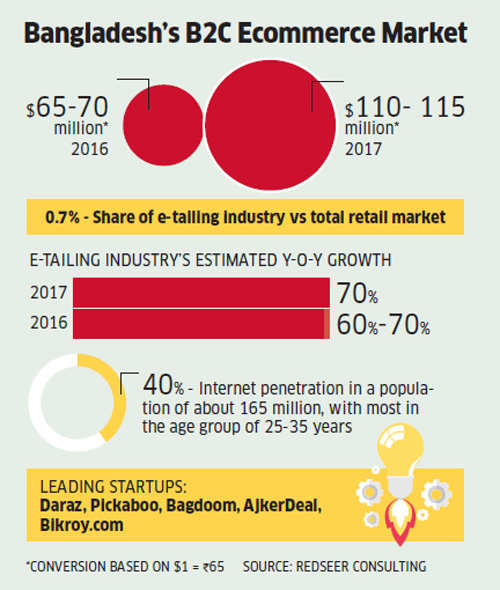
The rollout of 3G internet in Bangladesh 3-4 years ago led to rapid adoption of online shopping there. The country’s e-tailing sector is expected to grow 70% in 2017, according to RedSeer Consulting. Internet penetration to 40% of Bangladesh’s 165-million population has bolstered the growth of local ecommerce, F-commerce (merchants conducting online business through Facebook pages) and e-grocery startups.

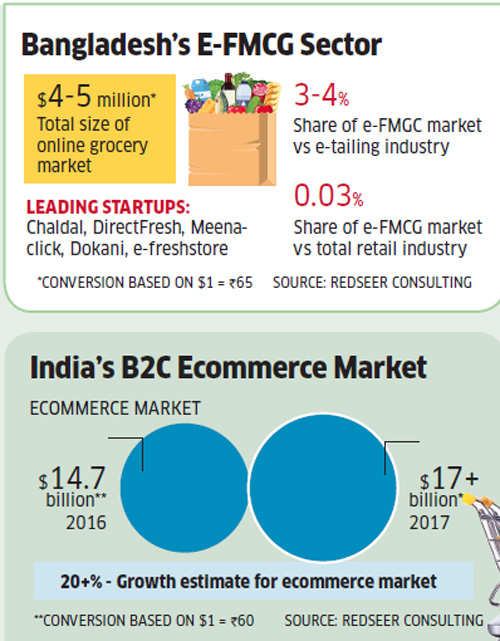
Rocket Internet-backed online marketplace Daraz, Foxconn-backed e-retailer Pickaboo, and Chaldal are among the leading startups in this fairy nascent ecosystem. The size of Bangladesh’s ecommerce market is estimated to be $110-115 million this year, which is a mere 0.7% of the country’s total retail market, according to RedSeer Consulting. To put that in perspective, India’s ecommerce market is estimated to cross $17 billion this year.

The size of Bangladesh’s egrocery market is much smaller at $4-5 million, or about 0.03% of the country’s overall grocery market. Even so, analysts are predicting that Bangladesh’s ecommerce market will surge to $20 billion by 2020, by when, according to Goldman Sachs, India’s online retail market is expected to reach $69 billion.

Global investors heading to India are beginning to make a stopover at Bangladesh

Global investors heading to India are beginning to make a stopover at Bangladesh

Bangladesh’s ecommerce market is “nascent but growing— similar to what India was probably seven years ago. It’s a good time for ecommerce players to be entering,” said Shalini Prakash, venture partner at 500 Startups, which has invested in more than 50 companies in India since 2011.

“We are a global fund. So we are looking at founders and startups that are looking to solve interesting problems across the globe for the local market.”

Daraz, founded in 2014, dominates Bangladesh’s ecommerce market, selling electronics, mobile phones, large appliances and apparel. The company is growing at double-digit percentages every month, supplying to customers in neighbouring markets Pakistan, Sri Lanka, Nepal and Myanmar as well.

The opportunity in Bangladesh prompted Delhi-based digital marketing company MoMagic Technologies to launch Pickaboo there last year. “The Bangladesh ecommerce market is close to five years behind the Indian ecommerce market and is around 10-12% of the size of the Indian ecommerce market,” said Arun Gupta, chief executive of MoMagic. “We identified Bangladesh as a potential opportunity and decided to launch Pickaboo.”


Pickaboo, which clocks monthly revenues of $600,000, mostly sells electronics on its controlled marketplace and has plans to add leather accessories shortly.

“When Flipkart was launched, they started selling books first— a category where what you see on the marketplace and what you receive is the same. In today’s world, electronics fall under this category with the probability of difference being low,” said Gupta, adding that Pickaboo has a 20% share of Bangladesh’s ecommerce market. 

International Finance Corporation (IFC), the private sector lending and investment arm of the World Bank, has been tracking Bangladesh’s entrepreneurial ecosystem the past year and is bullish about the market.

It has shortlisted and is actively monitoring 43 startups, including Chaldal topping the list as a potential investee company. 

Chaldal, somewhat similar to India’s largest e-grocer Big Basket, delivers groceries using a network of small warehouses spread across Dhaka. “We launched Chaldal because we felt that there was a need to offer more variety of groceries to our customers,” said CEO Alim. “As the country develops there is a need to provide services that save time for the growing middle class.”

Chaldal competes with Direct Fresh and Meena Click, the online extension of Bangladesh’s 15-year-old supermarket chain Meena Bazaar. Specialising in groceries and personal care products, Meena Click was launched three years ago. The company, which handles 4,000-4,500 orders a month in Dhaka and the port city of Chittagong, said it has doubled its business over the past year.
“The grocery market is huge with limited superstore penetration and we feel that the online model would help us achieve scale that no other player in the market has,” said Alim. The online grocery startup reached out to its counterparts across the world, including Indian companies Big Basket and Grofers, to exchange notes. “The learning has mostly been around what (Big Basket and Grofers) think is important to customers— tradeoffs between quality, speed, etc.,” said Alim.

This also led to a realization that despite the geographical proximity, Bangladeshi startups operated in a different environment.

“Indian players have been able to use capital to get a starting boost. Grofers, for example, for fast-growth by spending on marketing, while Big Basket invested heavily in operations and getting quality right,” said Alim. 

Another aspect about this nascent ecommerce market is that of the total online spending by customers, which is estimated to be about $50 million, 40% of the transactions are through 15,000 small merchants selling through their Facebook pages.

Bangladesh’s ecommerce “ecosystem, instead of developing around one or two big players, has several smaller merchants who sell online,” said Ruchira Shukla, regional lead, South Asia, venture capital, at IFC, which is also an investor in India’s biggest online grocer Big Basket.

Due to Bangladesh’s rapidly growing economy and urban population, IFC believes now is the right time to make some early bets in the country’s startup ecosystem. “The metrics point to healthy growth in Bangladesh… We are looking at some earlierstage investments than what we do in India—most likely at the series-A level financing along with other investors,” said Shukla. 

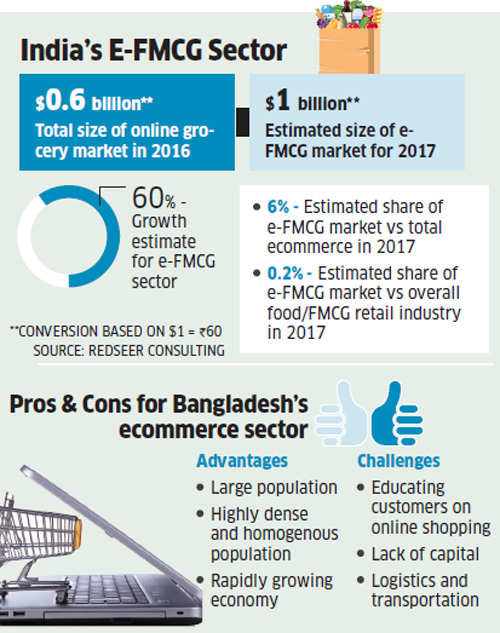
Bangladesh also has the advantage of a large and homogenous population of 165 million. Because of this, “once the business model is figured out, it can be scaled across several cities and the entrepreneur doesn’t have to worry about differences in language or culture,” Shukla said.

That said, Bangladesh has fewer large and dense cities when compared with India, which poses tough limitations to growth by expansion. 

The market is fraught with several other challenges too. “Logistics and the transportation system are still challenges in Bangladesh,” said a spokesperson for Daraz, which said it has the largest delivery network in the country, with its own fleet operating in 20 cities. “Also, the stagnant traffic hampers fast delivery of products.” 

Educating customers is also an uphill task. Alim recalled being at the receiving end of “a lot of snarky remarks related to a Wharton education going to waste on becoming a grocer. People still think that I might end up doing something ‘real’ later in life.” Consumer brands, too, used to be skeptics. “When we started Chaldal, we could not find good pictures of the products we were selling (for a catalogue) and companies like Unilever were not helpful in providing us with pack shots,” said Alim.

Then, he had his light-bulb moment.

The Chaldal team rented out a small grocery for two hours to click pictures of all the items it stocked to build their online catalogue.

“Basically, we paid some money to keep the store open for an extra two hours and set up a photo studio inside. The pictures looked horrible but at least we got them up on a website.” 

Another big challenge lies in how to turn around the market despite a shortage of capital. This has forced some companies to resort to capital-efficiency to survive.

“Part of the capital-efficiency comes from us having very little capital available in the ecosystem— we have had to innovate significantly beyond the practices in the Indian market,” said Alim, who took inspiration from Big Basket’s warehouse to start their own in Dhaka. Chaldal now has five small warehouses and one sourcing hub in Dhaka. 

Thursday, 16 November 2017

COD payments at e-commerce firms back to pre-demonetisation levels

COD payments are higher in Tier 2 and Tier 3 cities as compared to Tier 1 cities where customers are more inclined to pay by card on delivery or make online payments. Photo: Indranil Bhoumik/Mint
New Delhi/Bengaluru: A year after the government’s all-out effort to reduce cash usage and push digital payments after the invalidation of high-value banknotes, cash transactions at e-commerce firms have already returned to pre-demonetisation levels.
That’s an indication that hopes of a transformational shift toward digital payments in the aftermath of demonetisation, which caused an unprecedented cash crunch, are unlikely to be realized in an e-commerce market estimated where, according to Redseer Consulting, transactions reached $14.5-15 billion last year.
Cash transactions, which accounted for as much as 60-65% of all e-commerce orders in India until November 2016, dropped to as low as 45-55% after demonetisation took out 86% of the currency in circulation by value, according to executives at online retailers and logistics firms.
But as cash availability increased starting early this year, many shoppers immediately shifted away from digital payments. Now, cash again accounts for 60-65% of all e-commerce orders, these executives said.
Mint had reported on 8 November that demonetisation has failed to make a dent in cash usage in the Indian economy because of poor digital infrastructure and the ingrained habits of consumers, besides other reasons.
“Cash transactions are back to their old levels, or even higher very slightly,” said T.A. Krishnan, CEO of Ecom Express Pvt. Ltd, one of the largest logistics providers to online retailers. “E-commerce companies are going deeper into the country and in these areas (Tier 2-3 cities), consumers are paying by cash. Eighty percent of our deliveries are paid (for) with cash.”
According to Krishnan’s estimates, some 70% of all e-commerce orders currently are paid for with card or cash on delivery.
“We see no positive shift towards credit or debit cards and the COD (cash on delivery) orders have gone back to old levels. In smaller markets (Tier 2 and 3 cities) this number is up by 5-7 (percentage points),” said Abhishek Chakraborty, executive director at DTDC Express Ltd, a logistics firm.
DTDC ships close to 1 million orders a month. The firm had seen prepaid orders touch about 70% of the overall e-commerce business soon after demonetisation, and this number is now back to about 60%.
Hyperlocal delivery firm Shadowfax Technologies Pvt. Ltd said it has also seen a jump of 5 percentage points in COD orders in the last three months. Shadowfax is one of the biggest external logistics providers to online food and grocery delivery companies.
According to Sanjeev Kathuria, CEO of courier firm Dotzot, COD orders saw a sharp fall after demonetisation but returned to normal levels soon after.
“The overall orders for the e-commerce industry saw a dip post November 2016 but we have not seen people switch to credit or debit card transactions, as was anticipated,” Kathuria added.
Flipkart and Amazon India, India’s two largest online retailers, have seen a slight decline in the proportion of cash orders delivered by their own logistics units, executives at the companies said on condition of anonymity.
Flipkart and Amazon, which also use third-party logistics providers, have been pushing customers to use their digital payment platforms, PhonePe and Amazon Pay, to pay for orders. But on an overall basis, a large number of their orders still continue to be paid by cash.
Flipkart declined to comment for this story. Without giving numbers, Amazon India (Amazon Seller Services Pvt. Ltd), the second-largest e-commerce firm, said the proportion of its cash orders has reduced this year compared with the levels before demonetisation.
“Due to the demonetisation in November 2016, people began to adopt electronic payment methods resulting in reduced cash usage. While cash began returning by end of Q1FY17, by then, we had taken several initiatives to encourage digital payments include providing point of sale machine delivery agents and supporting customers in making electronic payments when they deliver across thousands of pin codes across the country. COD (cash on delivery) share in Tier 2/3 cities is higher than Tier 1 but the gap is narrowing, as a result of our initiatives to drive electronic preference,” an Amazon spokesperson said in an email.