 Kolkata: Telecom companies have asked the country’s big online marketplaces Amazon, Flipkart, Snapdeal, ShopClues and Rediff.com to stop the sale of mobile signal boosters and repeaters on their webstores/platforms, saying possession and sale of such wireless gear is illegal and a punishable offence under the Indian Wireless Telegraph Act of 1933.
The Cellular Operators Association of India (COAI), in identical letters to these digital majors, has also said “usage of such wireless telegraphy apparatus by end-customers creates severe interference in the licensed frequency bands assigned to telcos, impacting the overall quality of (mobile) services”.
ET has seen these letters that are marked to GK Agarwal, wireless advisor in the Department of Telecommunications (DoT).
COAI has noted that the specifications of boosters and repeaters sold online claim that these devices enhance signals across the 800 MHz, 900 MHz, 1800 MHz, 2100 MHz and 2300 MHz licensed spectrum bands, which are assigned to telecom carriers.
Accordingly, the COAI, which represents Vodafone Idea, Bharti Airtel and Reliance Jio, has called on these big online retailers “to immediately cease and desist” from selling mobile signal boosters and repeaters that fall under the definition of ‘wireless telegraphy apparatus’ and ‘wireless transmitter’ under the Indian Wireless Telegraph Act.
“It is pertinent to note that possession and sale of such equipment, without obtaining requisite permissions under the Wireless Telegraph Act and rules framed thereunder, constitutes violation of the provisions and is a punishable offence under Section 6 of the Act,” Rajan Mathews, director general of COAI, said in letters to the online marketplaces.
Mathews has also cited a DoT letter of May 10, 2016 that had conveyed to the online/e-commerce companies that under Indian Wireless Telegraphy (Possession) Rules, 1965, “no person/dealer shall sell or hire a wireless set/equipment to any person, unless they hold a valid dealer possession licence (DPL)”.
Further, the DPL holder, according to DoT’s letter, “can sell (such) wireless sets/equipment only to such person/entity that holds an authorisation issued by the communications ministry to establish a wireless telegraph under the Indian Telegraph Act, 1885”.
Further, DoT’s communique of May 2016, cited by COAI, had noted that in case there is any licensing/statutory requirement on telecom gear being sold or purchased, “it would be the responsibility of those selling it or purchasing it, as well as of the online intermediaries facilitating such sale and purchase, that the relevant statutes of the government are not violated”.
In response to ET’s queries, an Amazon spokesperson said sellers selling their products through the amazon.in marketplace are “solely responsible for all necessary product compliance and are required to sell products which are legally allowed to be sold in India”.
Kolkata: Telecom companies have asked the country’s big online marketplaces Amazon, Flipkart, Snapdeal, ShopClues and Rediff.com to stop the sale of mobile signal boosters and repeaters on their webstores/platforms, saying possession and sale of such wireless gear is illegal and a punishable offence under the Indian Wireless Telegraph Act of 1933.
The Cellular Operators Association of India (COAI), in identical letters to these digital majors, has also said “usage of such wireless telegraphy apparatus by end-customers creates severe interference in the licensed frequency bands assigned to telcos, impacting the overall quality of (mobile) services”.
ET has seen these letters that are marked to GK Agarwal, wireless advisor in the Department of Telecommunications (DoT).
COAI has noted that the specifications of boosters and repeaters sold online claim that these devices enhance signals across the 800 MHz, 900 MHz, 1800 MHz, 2100 MHz and 2300 MHz licensed spectrum bands, which are assigned to telecom carriers.
Accordingly, the COAI, which represents Vodafone Idea, Bharti Airtel and Reliance Jio, has called on these big online retailers “to immediately cease and desist” from selling mobile signal boosters and repeaters that fall under the definition of ‘wireless telegraphy apparatus’ and ‘wireless transmitter’ under the Indian Wireless Telegraph Act.
“It is pertinent to note that possession and sale of such equipment, without obtaining requisite permissions under the Wireless Telegraph Act and rules framed thereunder, constitutes violation of the provisions and is a punishable offence under Section 6 of the Act,” Rajan Mathews, director general of COAI, said in letters to the online marketplaces.
Mathews has also cited a DoT letter of May 10, 2016 that had conveyed to the online/e-commerce companies that under Indian Wireless Telegraphy (Possession) Rules, 1965, “no person/dealer shall sell or hire a wireless set/equipment to any person, unless they hold a valid dealer possession licence (DPL)”.
Further, the DPL holder, according to DoT’s letter, “can sell (such) wireless sets/equipment only to such person/entity that holds an authorisation issued by the communications ministry to establish a wireless telegraph under the Indian Telegraph Act, 1885”.
Further, DoT’s communique of May 2016, cited by COAI, had noted that in case there is any licensing/statutory requirement on telecom gear being sold or purchased, “it would be the responsibility of those selling it or purchasing it, as well as of the online intermediaries facilitating such sale and purchase, that the relevant statutes of the government are not violated”.
In response to ET’s queries, an Amazon spokesperson said sellers selling their products through the amazon.in marketplace are “solely responsible for all necessary product compliance and are required to sell products which are legally allowed to be sold in India”.
 Top venture capital (VC) investors like SAIF Partners, Sequoia CapitalIndia and Matrix Partners India are making about half a dozen early bets on a new set of e-commercecompanies. These startups are catering to the next 100 million internet users who have come to the e-market. The startups — Bulbul, Simsim, WMall, Mall91 and DealShare — are using vernacular language to make the user comfortable and also make shopping social as they look to tap consumers who are still not comfortable on platforms like Flipkart and Amazon India.
 While DealShare is in talks to raise $2-3 million from New York-based hedge fund Falcon Edge and Matrix Partners India, WMall is likely to bag $1-2 million from SAIF Partners. Bulbul — a video-based e-commerce platform — is being backed by Sequoia Capital, while Mall91 is raising Rs 5-7 crore from Beenext, said sources in the VC industry. Most of these platforms are still testing their products and are in beta stage. When contacted, these companies declined to comment on their fund-raising. Matrix Partners said it has no comments to offer. Emails sent to the other investors did not elicit any response till the time of going to press.
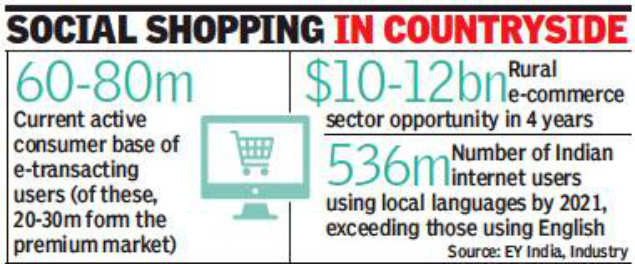
Besides tier-2 and -3 towns, even the tier-1 market has businessmen, housewives and other consumers who are not used to shopping online in a foreign language, setting multiple filters, said Amit Bagaria, co-founder of vernacular e-commerce platform Simsim. “A relative of mine calls me every time he needs to place an order online. He is well educated with adequate disposable income. He is almost intimidated by these platforms, which is why they go to offline stores or shopping malls and that’s the behaviour we are aiming to change,” said Bagaria, who has worked for seven years in senior roles at Flipkart and Paytm. Some of these platforms are also leveraging the bargain-hunting and social-shopping behaviour to build trust. For instance, Jaipur-based DealShare rewards a user based on the number of times he or she is able to share a deal with friends and family who eventually buy it. The more people you can nudge to buy, the higher your incentives are. WMall is experimenting with sending deals to customers on WhatsApp on a daily basis. “The window-shopping concept is not being catered to by the likes of Amazon or Flipkart. But people have started realising social channels can be used to drive this behaviour. Now there are sellers on Facebook, Instagram too,” said Harmin Shah, co-founder of WMall.Product categories on these platforms are also different with unbranded fashion, household products, beauty and other accessories being the focus areas, unlike exclusive smartphones, large appliances and other branded goods for such platforms as Flipkart and Amazon India. What has encouraged these startups is the IPO — at a $25-billion valuation — of China-based group-discounting platform Pinduoduo, which has been able to carve out a significant share against dominant platforms Alibaba and JD.com in that country. The leading internet companies are after the 80 million users who transact regularly, said analysts. At the end of 2018, India had 462 million internet users, according to data platform Statista, and new e-commerce firms hope they can get the first 100 million of the new users. Investors feel that some of these new platforms can also create a niche market, and that new channels for e-commerce will emerge, according to Rahul Chowdhri, partner at Stellaris Venture Partners. “Using social, selling mobiles might be hard, which is a branded item and a structured space. But selling fashion is very obvious. So certain segments would work and some won’t,” he said.
While DealShare is in talks to raise $2-3 million from New York-based hedge fund Falcon Edge and Matrix Partners India, WMall is likely to bag $1-2 million from SAIF Partners. Bulbul — a video-based e-commerce platform — is being backed by Sequoia Capital, while Mall91 is raising Rs 5-7 crore from Beenext, said sources in the VC industry. Most of these platforms are still testing their products and are in beta stage. When contacted, these companies declined to comment on their fund-raising. Matrix Partners said it has no comments to offer. Emails sent to the other investors did not elicit any response till the time of going to press.
Besides tier-2 and -3 towns, even the tier-1 market has businessmen, housewives and other consumers who are not used to shopping online in a foreign language, setting multiple filters, said Amit Bagaria, co-founder of vernacular e-commerce platform Simsim. “A relative of mine calls me every time he needs to place an order online. He is well educated with adequate disposable income. He is almost intimidated by these platforms, which is why they go to offline stores or shopping malls and that’s the behaviour we are aiming to change,” said Bagaria, who has worked for seven years in senior roles at Flipkart and Paytm. Some of these platforms are also leveraging the bargain-hunting and social-shopping behaviour to build trust. For instance, Jaipur-based DealShare rewards a user based on the number of times he or she is able to share a deal with friends and family who eventually buy it. The more people you can nudge to buy, the higher your incentives are. WMall is experimenting with sending deals to customers on WhatsApp on a daily basis. “The window-shopping concept is not being catered to by the likes of Amazon or Flipkart. But people have started realising social channels can be used to drive this behaviour. Now there are sellers on Facebook, Instagram too,” said Harmin Shah, co-founder of WMall.Product categories on these platforms are also different with unbranded fashion, household products, beauty and other accessories being the focus areas, unlike exclusive smartphones, large appliances and other branded goods for such platforms as Flipkart and Amazon India. What has encouraged these startups is the IPO — at a $25-billion valuation — of China-based group-discounting platform Pinduoduo, which has been able to carve out a significant share against dominant platforms Alibaba and JD.com in that country. The leading internet companies are after the 80 million users who transact regularly, said analysts. At the end of 2018, India had 462 million internet users, according to data platform Statista, and new e-commerce firms hope they can get the first 100 million of the new users. Investors feel that some of these new platforms can also create a niche market, and that new channels for e-commerce will emerge, according to Rahul Chowdhri, partner at Stellaris Venture Partners. “Using social, selling mobiles might be hard, which is a branded item and a structured space. But selling fashion is very obvious. So certain segments would work and some won’t,” he said.
 Amazon on Wednesday unveiled plans to open more bookstores and "4-star" shops selling only the best-rated products -- while closing its smaller "pop-up" kiosks in the US."After much review, we came to the decision to discontinue our pop-up kiosk program, and are instead expanding Amazon Books and Amazon 4-star," a spokeswoman told AFP. "We look forward to opening additional locations of both stores this year."According to CNBC, the 87 pop-up stores in the US will close next month. Launched in 2014, the stands -- located in shopping centers or in other stores, such as Amazon-owned Whole Foods -- offered the company's services and electronics.
The announcement confirms Amazon's goal to strengthen its real-world presence with more, larger physical outlets.The Wall Street Journal reported last week that the firm, owned by billionaire Jeff Bezos, plans to open a supermarket chain separate from Whole Foods -- with the first expected in Los Angeles at the end of this year.The firm opened its first "4-star" shop in New York in September, with stock made up solely of products given a four and five-star rating on its website.In early 2018, the group also opened its first "Amazon Go" store in Seattle -- a grocery outlet without a checkout, where purchases are recorded by cameras and sensors.
Amazon on Wednesday unveiled plans to open more bookstores and "4-star" shops selling only the best-rated products -- while closing its smaller "pop-up" kiosks in the US."After much review, we came to the decision to discontinue our pop-up kiosk program, and are instead expanding Amazon Books and Amazon 4-star," a spokeswoman told AFP. "We look forward to opening additional locations of both stores this year."According to CNBC, the 87 pop-up stores in the US will close next month. Launched in 2014, the stands -- located in shopping centers or in other stores, such as Amazon-owned Whole Foods -- offered the company's services and electronics.
The announcement confirms Amazon's goal to strengthen its real-world presence with more, larger physical outlets.The Wall Street Journal reported last week that the firm, owned by billionaire Jeff Bezos, plans to open a supermarket chain separate from Whole Foods -- with the first expected in Los Angeles at the end of this year.The firm opened its first "4-star" shop in New York in September, with stock made up solely of products given a four and five-star rating on its website.In early 2018, the group also opened its first "Amazon Go" store in Seattle -- a grocery outlet without a checkout, where purchases are recorded by cameras and sensors.
 BENGALURU: As mobile wallets grapple with regulatory constraints, startupsworking around the buy-now-pay-later model sense fresh opportunity by leveraging the ease of transaction they offer.Industry insiders said mobile wallets, which were originally positioned as a single-click checkout process for online commerce, can slowly give way to a tab systemwhere consumers can make purchases in one go and pay in bulk later. They might not be as mass market as wallets, but from a checkout convenience factor, they could be better than wallets.Success rate for transactions on this mode are as high as 99%, which is one of the major selling points for ecommerce companies, according to the insiders. Nityanand Sharma, who cofounded Simpl, said that his product leverages the age-old ‘khata’ system, where the local grocer or the merchant maintained a notebook and the consumer would pay in bulk at the end of the month.
“The practice of keeping a ‘tab’ is an old tradition in India and permeates from large cities to small towns and villages. We want to build Simpl as a massmarket product in that fashion based on people’s trust,” he said. Sharma said that mobile wallets could hardly offer a single click checkout option because in more than 80% cases a consumer would need money to be added to the wallet during the purchase. A product like Simpl, on the other hand, offers the true single-click checkout option.
BENGALURU: As mobile wallets grapple with regulatory constraints, startupsworking around the buy-now-pay-later model sense fresh opportunity by leveraging the ease of transaction they offer.Industry insiders said mobile wallets, which were originally positioned as a single-click checkout process for online commerce, can slowly give way to a tab systemwhere consumers can make purchases in one go and pay in bulk later. They might not be as mass market as wallets, but from a checkout convenience factor, they could be better than wallets.Success rate for transactions on this mode are as high as 99%, which is one of the major selling points for ecommerce companies, according to the insiders. Nityanand Sharma, who cofounded Simpl, said that his product leverages the age-old ‘khata’ system, where the local grocer or the merchant maintained a notebook and the consumer would pay in bulk at the end of the month.
“The practice of keeping a ‘tab’ is an old tradition in India and permeates from large cities to small towns and villages. We want to build Simpl as a massmarket product in that fashion based on people’s trust,” he said. Sharma said that mobile wallets could hardly offer a single click checkout option because in more than 80% cases a consumer would need money to be added to the wallet during the purchase. A product like Simpl, on the other hand, offers the true single-click checkout option.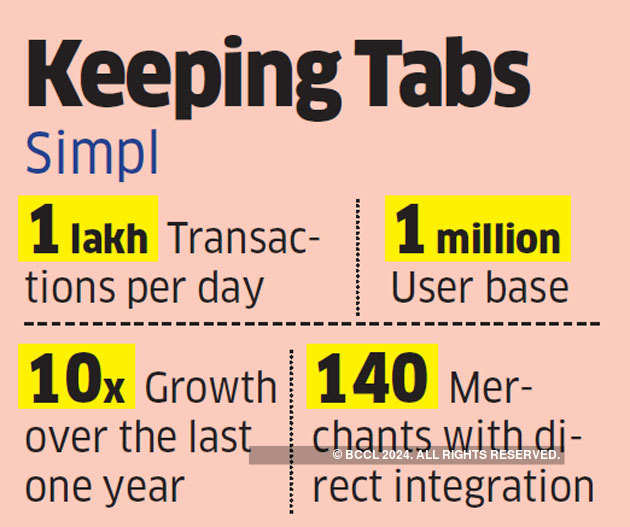 Jitendra Gupta, who heads LazyPay, said buy-now-pay-later is a typical credit product for consumers who are otherwise not eligible for a credit card. This helps ecommerce companies serve those who might not have a credit card but the purchasing capacity. “A top food delivery startup told us that loyalty of customers using LazyPay is much higher and their stickiness is also growing,” Gupta said.“Merchants look at entities like us from a convenience factor, but a consumer looks at it both as a convenient payment option as well as a credit card replacement.” Gupta said that 70% of the repayments on LazyPay are happening through debit cards, net banking or Unified Payments Interface (UPI), which indicates that the users do not have credit cards.LazyPay is disbursing around 1.6 million loans per month. Besides a pay-later feature, it has a personal loans product, too. “What wallets targeted initially, pay-later products can successfully achieve. It can convert cashon-delivery purchases into digital payments,” said Aurko Bhattacharya, cofounder of ePayLater, a Mumbai-based startup working in the same space. “Consumers here get the product delivered and pay later when the bill is due.”Though these instruments are poised to compete with the mobile wallets from a convenience point of view, Gupta feels they can never be a mass-market product like mobile wallets. “It is like post-paid accounts for telecom companies. It will be only for a select group of people and hence users of this product will continue to be a small part of the entire wallet user base,” he said.
 BENGALURU: Taking on popular subscription programmes of Amazon (Prime) and Flipkart, mobile payments major Paytm is set to start its own subscription programme — Paytm First — as it looks to catch up with rivals. The Ant Financial and Softbank-backed company is looking to on-board about 3 million subscribers in the first year, investing about Rs 250 crore in this line of business hoping it would cut its user attrition rate by at least 50%. Paytm First is looking at a mix of exclusive incentives for consumers, both within its ecosystem of products like payments, movies and travel besides external partners like Zomato, Gaana and Uber. At this stage, the Noida-based company has priced the annual subscription at Rs 750. Amazon's annual subscription is priced at Rs 999 while Flipkart's loyalty programme Plus is not a paid service, where consumers earn digital coins on every purchase which they can redeem on subsequent transactions on Flipkart.
“We will aggressively market this subscription product. We have already seen merchants joining us with as much as 80% discount on pricing of their products and services to be part of Paytm First,” said Deepak Abbot, SVP, Paytm. The company is said to have over 50 million monthly active users, one of the highest among top-internet companies. Abbot declined to give specific details on these metrics. As per a note by Barclays last year, Amazon has about 7 million paid Prime subscribers in India. Amazon had launched Prime here in 2016 at Rs 499 per year as inaugural offer to on-board users. According to industry executives, subscription programmes like Prime are to retain the premium layer of consumers so that they keep spending on these platforms. Out of the 80 million annual active users who transact online, about 20-30 million are the most-valued by these companies. For instance, out of every three product sold on Amazon India, one is bought by a Prime subscriber. "This is for consumer retention, clearly. This could give Paytm the advantage against rising competition in the core payments play from PhonePe, Google. While Amazon is a preferred shopping destination, it remains to be seen how this will play out for a player like Paytm. Subscription products that are simple and easy to use will see good adoption," said Satish Meena, senior forecast analyst, Forrester — a market research firm.
BENGALURU: Taking on popular subscription programmes of Amazon (Prime) and Flipkart, mobile payments major Paytm is set to start its own subscription programme — Paytm First — as it looks to catch up with rivals. The Ant Financial and Softbank-backed company is looking to on-board about 3 million subscribers in the first year, investing about Rs 250 crore in this line of business hoping it would cut its user attrition rate by at least 50%. Paytm First is looking at a mix of exclusive incentives for consumers, both within its ecosystem of products like payments, movies and travel besides external partners like Zomato, Gaana and Uber. At this stage, the Noida-based company has priced the annual subscription at Rs 750. Amazon's annual subscription is priced at Rs 999 while Flipkart's loyalty programme Plus is not a paid service, where consumers earn digital coins on every purchase which they can redeem on subsequent transactions on Flipkart.
“We will aggressively market this subscription product. We have already seen merchants joining us with as much as 80% discount on pricing of their products and services to be part of Paytm First,” said Deepak Abbot, SVP, Paytm. The company is said to have over 50 million monthly active users, one of the highest among top-internet companies. Abbot declined to give specific details on these metrics. As per a note by Barclays last year, Amazon has about 7 million paid Prime subscribers in India. Amazon had launched Prime here in 2016 at Rs 499 per year as inaugural offer to on-board users. According to industry executives, subscription programmes like Prime are to retain the premium layer of consumers so that they keep spending on these platforms. Out of the 80 million annual active users who transact online, about 20-30 million are the most-valued by these companies. For instance, out of every three product sold on Amazon India, one is bought by a Prime subscriber. "This is for consumer retention, clearly. This could give Paytm the advantage against rising competition in the core payments play from PhonePe, Google. While Amazon is a preferred shopping destination, it remains to be seen how this will play out for a player like Paytm. Subscription products that are simple and easy to use will see good adoption," said Satish Meena, senior forecast analyst, Forrester — a market research firm.
