Thursday, 7 March 2019

Paytm Money gets Rs 29 crore from parent company

Paytm Money gets Rs 29 crore from parent companyBENGALURU: Online platform for mutual fund investments Paytm Money has received Rs 28.8 crore in a fresh round of funding from its parent entity One97 Communications, according to filings with the registrar of companies (RoC). 

This round could be part of the overall $10 million that One97 Communication had committed to invest in the mutual funds platform in a span of 18 months. As per the filings, Paytm Money has raised close to Rs 55 crore between November last year and January 2019. This means its parent entity has fulfilled its initial commitment into the subsidiary.

Further filings with RoC also show that the authorised capital of Paytm Money has been increased to Rs 200 crore, indicating that in the coming months, One97 Communications could infuse more funds into Paytm Money.
The company did not respond to email queries from ET. Paytm Money, which is based out of Bengaluru, is a wholly owned subsidiary of One 97 Communications, which runs the country’s largest digital payments company Paytm. It competes with the likes of Zerodha and ET Money, which is run by Times Internet Limited, a part of the Times Group that publishes this newspaper.

Monday, 4 March 2019

Firms scramble to reply to draft ecommerce policy within a week

BENGALURU: US technology companies and Indian startups are working overtime to put together a response within a week to the government’s proposed ecommercepolicy, which is being touted as a digital economy policy that will have far-reaching impact on the country’s technology ambitions.

The policy deals with contentious subjects such as data dominance, data sovereignty and abuse of market power by big technology companies.

The proponents of the policy argue that India needs to protect its data to make it available for Indian startups while the opposing camp sees the policy as protectionist that will stifle innovation, foreign capital flow and hurt consumer choice. “This policy is not about only ecommerce, there is social media, cloud and everything in between,” said Nikhil Narendran, Partner at Trilegal. “It’s a huge hit on consumer choice. It’s like an internet blockade.”

The policy proposes that all ecommerce websites selling to Indian consumers and apps available for downloading in India have a registered business entity here. These technology companies must provide government access to source code, algorithms of AI systems and are barred from sharing of sensitive data of Indian users with third party entities, even with consent. The last date for response to the draft policy is March 9.

To ensure that India’s data is used for the country’s development, and Indian citizens and companies get the economic benefits from the monetisation of data, the policy proposes that antitrust regime must take into account the network effect — a phenomenon wherein increased numbers of people or participants improve the value of a goods or service.

This is especially true for social media and ecommerce platforms such as Facebook, Google and Amazon, where the winner dominates the market and the runner-up is a distant second. “I agree there is scope for government intervention to protect consumers because consumers sell their data for too little,” said Luigi Zingales, a professor at the University of Chicago Booth School of Business. “Facebook and Google get Indian data for little and make lots of money. India is big enough to form a union of suppliers and negotiate a better price for it.”

Emails sent to Facebook did not elicit a response as of press time Sunday, while Google and Amazon declined to comment.

Parminder Singh, executive director at IT for Change, a Bengaluru-based NGO, agreed that there is a risk of establishing an Indian technology monopoly instead of a foreign one. But India needs to fight one battle at a time, said Singh who was part of the drafting committee. “Data monopoly is a serious problem where a single company monopolises data and market intelligence,” he said. “The situation is similar to the 19th century industrial revolution. We are at a very formative age of social and economic change. These policies will determine the next 200 years.”

Many technology lawyers and think tanks feel that instead of demonising US companies, the government should make rules that encourage the Indian startup ecosystem to grow through tax incentives and friendly Indian equity investment rules. “The key issue is that we have to keep Indian consumers in mind,” said Arghya Sengupta, founder and research director at Vidhi Centre for Legal Policy.

“We have to create right incentives for startups in India to develop, so as to ensure a level playing field for them. You need competition for consumers to benefit. Any monopoly, Indian or US, is not good. US technology companies are (building) genuinely innovative products. We in India have to make innovative products at the same time.”

There is a global backlash against US technology companies that are being accused of abusing their market power through their data collection practices.

“Broadly speaking, there are two ways of operating in the digital economy — firstly, there is the ‘open’ approach followed by the United States and, secondly, there is the approach followed by China which constructs ‘walls’ and builds value internally,” said Rentala Chandrashekhar, former president of Nasscom. “The question is whether there is a third way which can be shown by India,” he said at the Competition Commission of India’s (CCI) panel discussion on Friday.

Apparel vendors on Flipkart will have to pay more commissions

Apparel vendors on Flipkart will have to pay more commissionsBENGALURU: Flipkart has increased the commissions it charges from vendors in the apparel category, a month after the latest FDI norms for online marketplaces kicked in.

Effective March 1, Flipkart has increased commissions it charges on western wear, kurtis, innerwear, smartwatches, blazers and waistcoats. The increase in commissions range between 6.5% and 15% across these segments. The smartwatch category has seen the highest change in commissions, increasing from 20% to 23%, representing a 15% hike for sellers. The commissions charged on western wear have increased from 15% to 16%, representing a 6.67% change.

Sellers said they received mails from Flipkart alerting them of the change in fee structure the day the changes were being introduced. Usually an online marketplace would intimate sellers 15 days to a month in advance.“Platforms need to propose any changes with proper consultation and time window. Flipkart should reverse these changes, or roll out unconditional incentives to negate effect of such changes,” said a member of the All India Online Vendor Association.

Flipkart did not respond to an emailed query sent by ET until press time. Industry experts said ecommerce marketplaces change their commissions based on business goals they have set for themselves. In this case, Flipkart could be turning on the revenue taps from the apparel category, which has become quite large over the years, said one person aware of the change. Apparel is the second biggest driver of gross merchandise value (GMV) for Flipkart and makes up the largest category in terms of volumes. The company has claimed that it is the single-largest online fashion destination, even excluding subsidiaries Myntra and Jabong.

Amazon last month slashed rates for categories such as fashion, among others as ET reported. While the US online retail giant did slash commissions by as much as 50% on FMCG products, it began rewarding highperforming sellers in the fashion segment with special rates.

Myntra-Jabong head reports to Flipkart fashion chief now

Myntra-Jabong head reports to Flipkart fashion chief nowMUMBAI: Amar Nagaram, head of fashion portals Myntra and Jabong, will now report to Rishi Vasudev who was recently elevated as the group head of fashion for Flipkart group, multiple people in the know said.

Earlier, Nagaram, who took over as the head of Myntra and Jabong after former CEO Ananth Narayanan quit, was reporting directly to Kalyan Krishnamurthy, group CEO of the Bengaluru-based ecommerce major.

The change in reporting for Nagaram reinforces the efforts being made by the group to build synergies between Myntra and Flipkart, and leverage its combined strength in the fashion category. The group sells fashion under Myntra, Jabong and Flipkart Fashion. “In the past, Myntra and Flipkart Fashion had been competing with each other, but now the group wants to collaborate going forward,” said one of the persons cited earlier. “The thinking within the group is to get the two companies to come together in the areas of sourcing products from various fashion labels and merchants, which till now was done separately by both the Myntra and Flipkart teams. ”
Myntra-Jabong head reports to Flipkart fashion chief now 
In another top-level change, Manohar Kamath, who was heading the private brands portfolio in fashion at Myntra, will now take over the category at Flipkart, too, another person in the know of the development said. Kamath will now be incharge of private brands (fashion) at the group level. Also, Myntra’s chief people officer Manpreet Ratia has taken on an advisory role with the group, sources said.

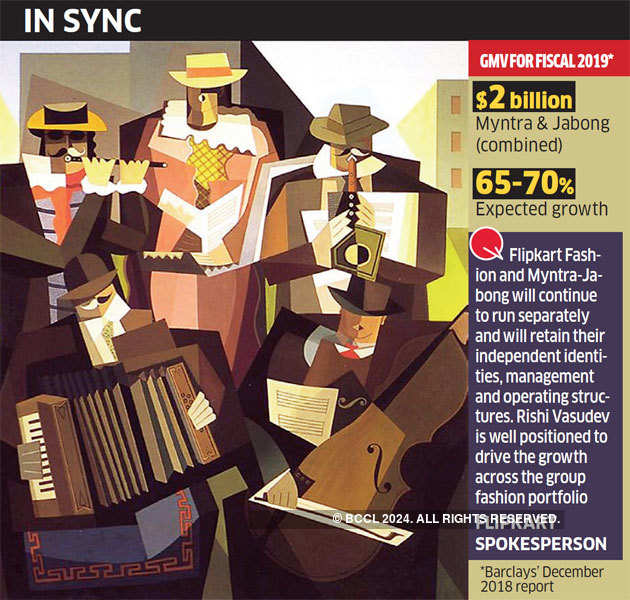
Replacing Ratia is Abhishek Sen, who was the HR and customer experience head at Myntra-Jabong. “While we do not comment on our internal structure and movements, we have positioned our fashion business to collaborate across both the organisations,” a Flipkart spokesperson told ET. “Rishi Vasudev, group head for Fashion, is a strong and accomplished business leader and well positioned to drive the growth across the group fashion portfolio.” The company spokesperson said Flipkart Fashion and Myntra-Jabong will continue to run separately and will retain their independent identities, management and operating structures.

Myntra and Jabong are collectively expected to generate $2 billion in gross merchandise value (GMV), growing at 65-70% for fiscal 2019, as per a report by Barclays released in December 2018.

Myntra has seen a stream of changes in its top deck with the exit of Narayanan. Flipkart’s mobile category head Ayyappan R was appointed to lead category management at the fashion portal even as Nagaram came on board, earlier this year.
Tuesday, 19 February 2019

Flipkart bets on alpha-beta tango to sync with FDI norms

Flipkart bets on alpha-beta tango to sync with FDI normsNEW DELHI: Flipkart is creating a layer of B2B (business-to-business) entities that will act as intermediaries between its wholesale arm and prominent sellers on its platform to comply with foreign investment rules for ecommerce marketplaces, people familiar with the development said.

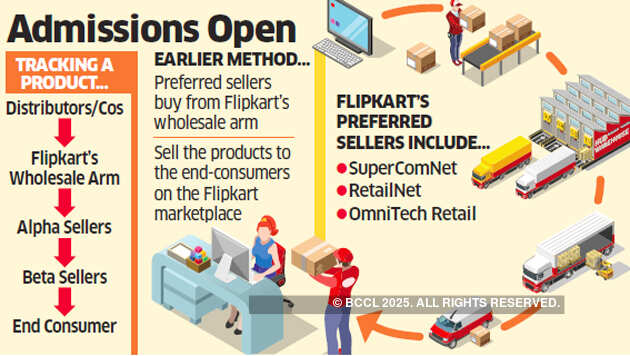
Flipkart, which Walmart. acquired for $16 billion in May, has appointed eight-nine such independent entities, code-named alpha sellers, which will buy goods from Flipkart India, the wholesale arm of the Flipkart Group, according to the people.

The alpha sellers will supply merchandise to beta sellers, which will offer them on the Flipkart marketplace. The introduction of the intermediary alpha sellers will help Flipkart meet a cap of 25% on vendors purchasing goods from entities related to marketplace operators, the people said.

Flipkart bets on alpha-beta tango to sync with FDI norms 

“Inventory of a vendor will be deemed to be controlled by ecommerce marketplace entity if more than 25% of purchases of such a vendor are from the marketplace entity or its group companies,” the government said in a note on December 26, prescribing norms that came into effect on February 1.

Previously, some “preferred sellers” of Flipkart including Super-ComNet, OmniTech Retail and RetailNet used to purchase products directly from Flipkart’s wholesale unit and sell them to consumers on the online marketplace.

These preferred sellers will now source most of their supplies from the B2B alpha distributors. Flipkart is enrolling more alpha intermediaries as well as consumer-facing beta sellers as part of its business restructuring, they said.

“Flipkart wholesale will invoice to alpha and then alpha sells it to beta,” said a person familiar with the plans. Flipkart said it is in compliance with the latest FDI rules. “At Flipkart marketplace, we are delighted to be serving as a platform for connecting lakhs of sellers and customers and committed to ensure sellers on our marketplace continue to access the consumers across the country efficiently and in a cost-effective way,” a Flipkart spokesperson said.

The top executive of a company that was approached to act as an intermediary said he was offered a “fixed” income for becoming an alpha seller. Another person familiar with the plans said Flipkart was offering “assured returns” or small percentages of commissions to intermediaries.

The December FDI announcements mandated both Flipkart and Amazon to overhaul their business models to stay compliant with norms that bar such marketplace operators from owing sellers on their platforms.

ET had reported on February 7 that Flipkart is in talks with retailers and distributors of Samsung, Xiaomi and FMCG products to enrol them on its platform to push sales while conforming to regulations for foreign-owned online marketplaces.