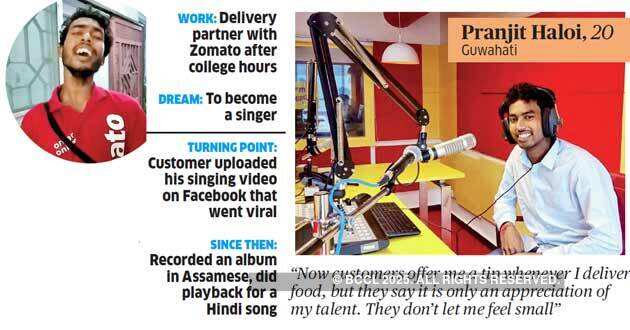
 Like all self-respecting youngsters in Guwahati, Pranjit Haloi had exciting plans for the New Year’s Eve.
The 20-year-old was going for a gig to the city’s popular Lalmati area. But he wasn’t there to join a throng of some 200 headbangers in the audience.
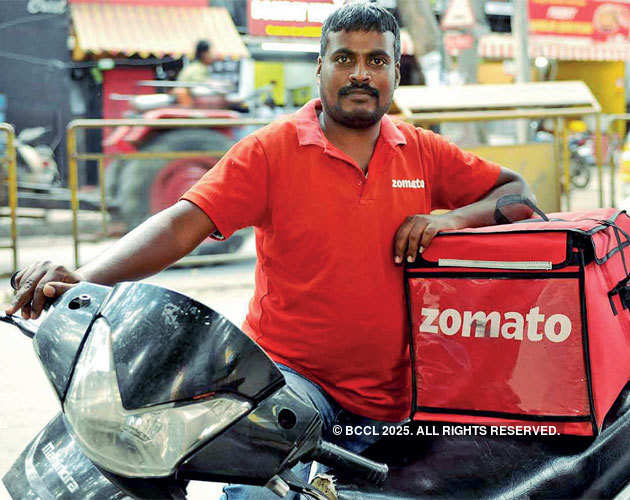
He performed on stage, to applause worthy of the new singing sensation in town. Next morning, on January 1, 2020, while some of his friends were nursing a hangover, Haloi got on a bicycle and rode off into the chilly Assamese air for his other gig — a delivery partner at Zomato.
Read also

For the last one year, Haloi, a first-year student, has been delivering food parcels across Guwahati after college hours. “When I joined Zomato, they asked me what my ultimate goal in life was. I said I wanted to be a good singer.”
Haloi couldn’t have known then that his singing ambition would make it to his short bio on the food delivery app, or that one day a customer reading this bio will bring him closer to his dream. On August 12, 2019, Anirban Chakraborty, an automobile sales professional from Guwahati, became that customer. He asked him to sing and then uploaded his singing video on Facebook the same evening.
Overnight, Haloi’s rendition of Gori Tera Gaao Bada Pyaara turned him into a social media star. Chakraborty’s Facebook video fetched over a million views, 24,000 likes and over 20,000 shares.
Since then, Haloi has recorded an album in Assamese and done playback for a Hindi song. However, the singing career is yet to bring in the monies, so the delivery gig continues. It is nothing like before though. In three out of the six or seven houses he delivers food to every day, people ask him to sing now. Restaurants make special song requests while he waits for the food to be cooked. “Customers offer me a tip, but they say it’s only an appreciation of my talent. They don’t let me feel small.”
The ubiquity of gig economy workers in urban lives — Uber drivers, food delivery agents, ecommerce couriers and on-demand service providers — today is such that it’s easy to forget that much of this has been around for less than half a decade. While the runaway success of delivery services has created jobs and opportunities (see pages 6-7), there is a parallel phenomenon underway—the cultural transformation of the delivery agent.
As earnings in this work have increased, it has started attracting people with youth and aspirations on their side, expressed on social media platforms. The men and women zipping past on two-wheelers on our roads now visibly signify the frenetic activity in a sunshine sector, much like cabs carrying call centre workers at night a decade ago.
Platforms in this sector, such as Urban-Clap, are ushering in a white-collar sheen to what used to be blue-collar pursuits, with upskilling, benefits and insurance cover. And finally, as companies humanise their personnel, publishing details of their lives, families and dreams, customers are according them greater respect and empathy.
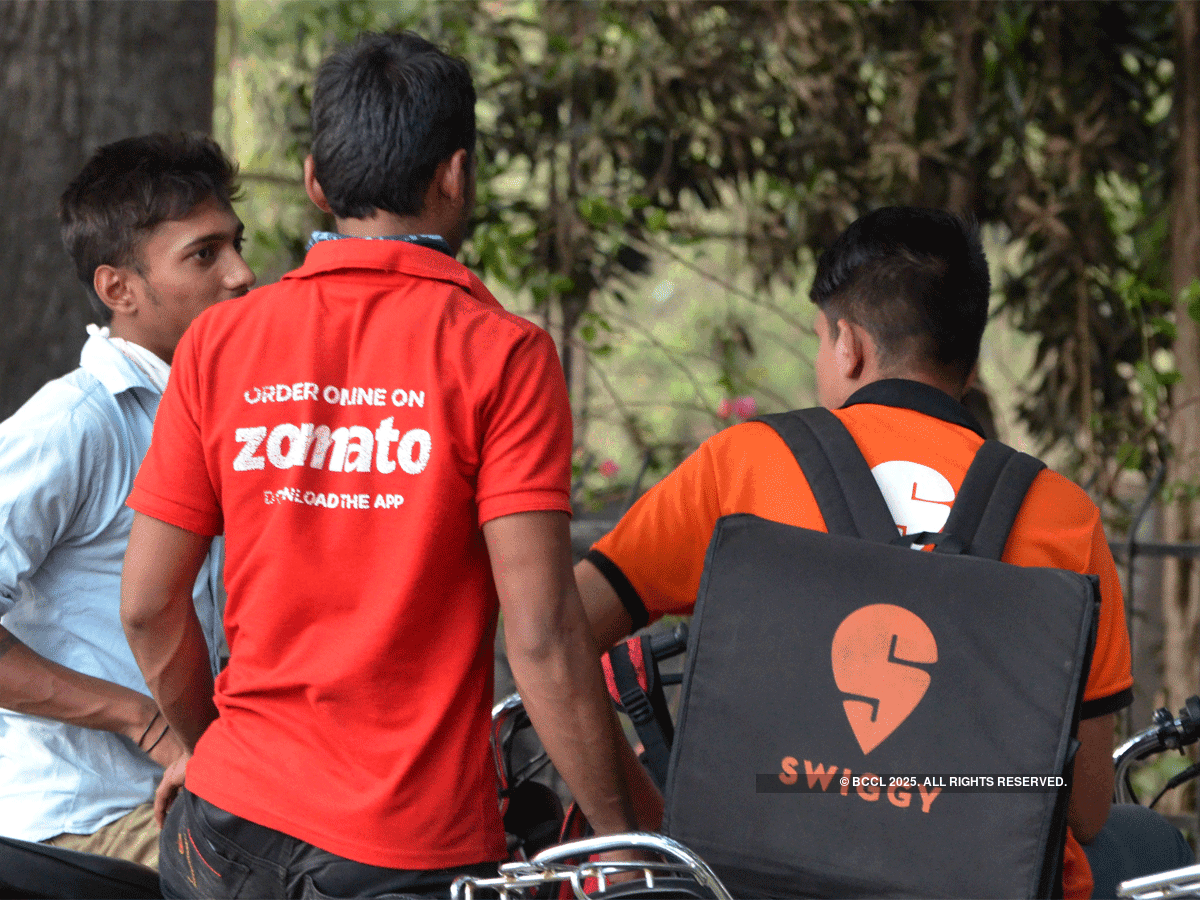
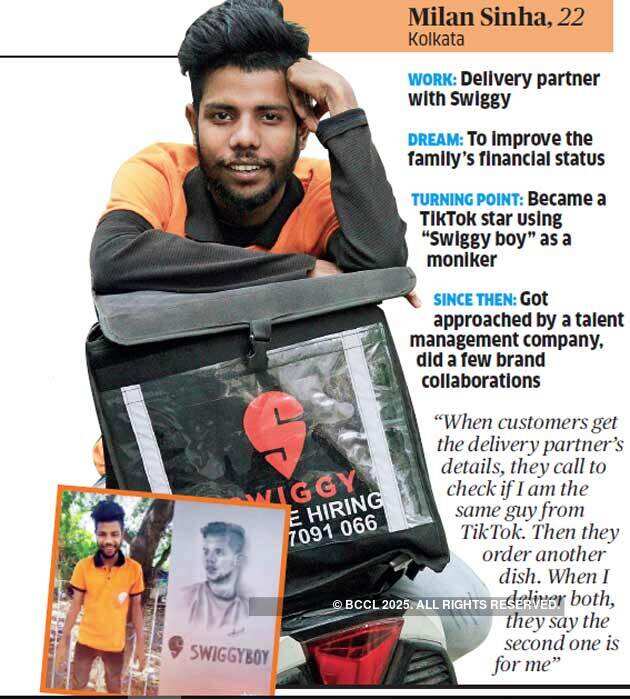
On many social media platforms, delivery boy is an identity with cultural cache. Milan Sinha, a 22-year-old gig economy worker, uses the moniker “Swiggy boy” for his Tik Tok and Instagram accounts, with several thousand followers.
When Nikhil Chinnari, an ad professional with BBH India, discovered Sinha from Kolkata on TikTok, he thought the Swiggy uniform was a gimmick or an avatar to woo users.
Slowly, his captions and videos about his work-life began to grow on Chinnari. Sinha’s videos, while made with the sole purpose of entertaining, also end up giving a peek into the life and mindset of the delivery personnel. The awkwardness of a former flame turning out to be a customer one is delivering food to, the possessiveness they feel for their delivery bag, and several such themes feature in Sinha’s 30-second videos. Owing to his popularity on Bytedance’s biggest videosharing social network in India, the “Swiggy boy” has been approached by talent management firms and small businesses for promotional videos, says Chinnari.
Over the last two years, leading global players of the gig economy, such as Amazon and Uber, and homegrown ones such as Zomato and Swiggy, have introduced several features and initiatives to bring stories of their service partners to the consumers.
Swiggy, for instance, has rolled out multiple nationwide campaigns that have put a face to their delivery partners, enabled greater consumer empathy by urging people to address them with their names instead of calling them “Swiggy”, and highlighted the dignity of labour.
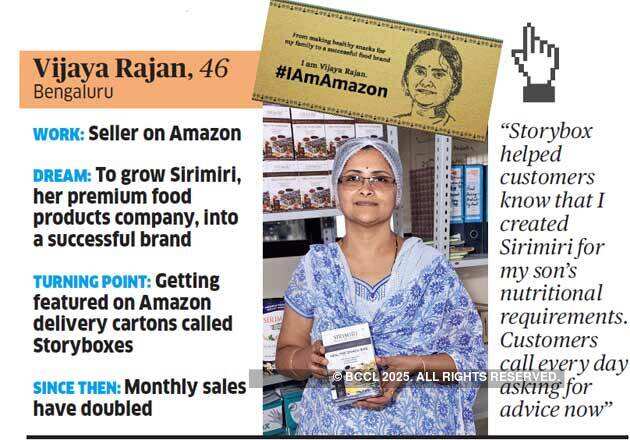
In January 2019, Amazon began an Indiafirst innovation, called Amazon Storyboxes, to humanise buyer-seller connect. Now customers across India receive their delivery cartons with transformative stories of Amazon sellers imprinted on them. A dotted sketch of the seller contains a QR code that allows user to check their entire product range available on the ecommerce platform.
So far, over a million customers have received these Storyboxes, says Gopal Pillai, VP of seller services at Amazon India.
Cab aggregator Uber also carries a short profile of their driving partners on the app now. This profile—that drivers can also access and edit—gives information to the rider about their driver’s personality traits, like their conversational skills, compliments left by other riders, and so on.
In June 2018, Zomato introduced something similar by adding a short bio of their delivery partners on the app. Simultaneously, it also added an option whereby users could tip the delivery personnel. Customers can tip even after completing the transaction as the delivery personnel’s details appear only once the bill is paid.
For the longest time, people in the service industry remained as faceless, nameless voices and phone numbers. Not many cared to know the name of the “Chottu” who delivered groceries from the neighbourhood grocery shop, the story of those making the food and clothing they bought, or the aspirations of their cab drivers. The online gig economy, with its resources, scale and networks, has changed this dramatically. More and more people are seeking personality and connection with this workforce because players of the digital economy are giving them the nudge that the traditional offline economy never could.
Ergo, from YouTube channels to TikTok videos to in-app bios and deliverycarton-imprints, the workforce of India’s gig economy is finding space on leading media platforms to be heard, noticed, and most of all, respected.
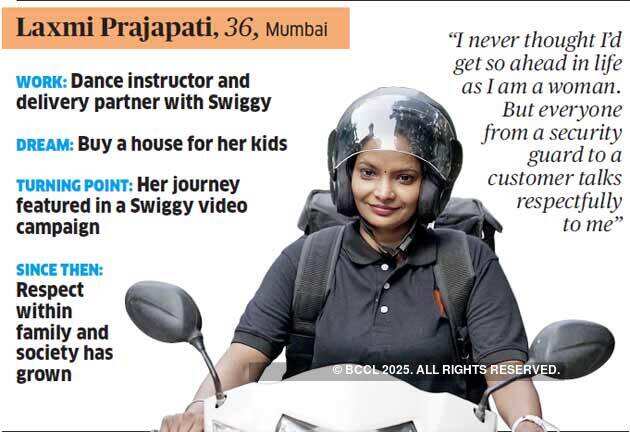
Laxmi Prajapati, 36, a Mumbai-based delivery partner with Swiggy, often gets requests from customers to take a selfie with her. In the star-studded city that she lives in, Prajapati knows only famous people are approached by strangers for selfies. Being a woman in a male-dominated line of work makes her unique, and allows her a taste of that fame. “I never thought I’d get so ahead in life as I am a woman. But everyone from a building’s security guard to a customer talks respectfully to me,” says the 36-year old who also works as a dance instructor for kids in the city’s Malad suburb.
The humanisation of the gig economy makes sense in the Indian context because there is no culture of tipping or treating the service class with empathy here so this helps build more empathy towards them, notes Gaurav Sabnis, associate professor of marketing at Stevens Institute of Technology, New York. “In the US, there’s a widely accepted culture of tipping. Even the likes of Uber and Lyft have an option to tip the driver on the app now,” he says.
The millennials and GenZ, at least in the metros, are used to tipping in India, says Gayatri Sapru, an anthropologist and cultural strategist. “But this humanisation exercise is nudging even the GenX towards tipping, which is a significant cultural change,” she adds.
It is because of this app-led humanisation that Haloi from Guwahati can envisage a promising career in singing now. In Indore, 27-year-old lawyer Ayusha Agrawal offered someone a tip for the first time ever because she read in the delivery person’s bio that he was the sole bread-winner of his family.
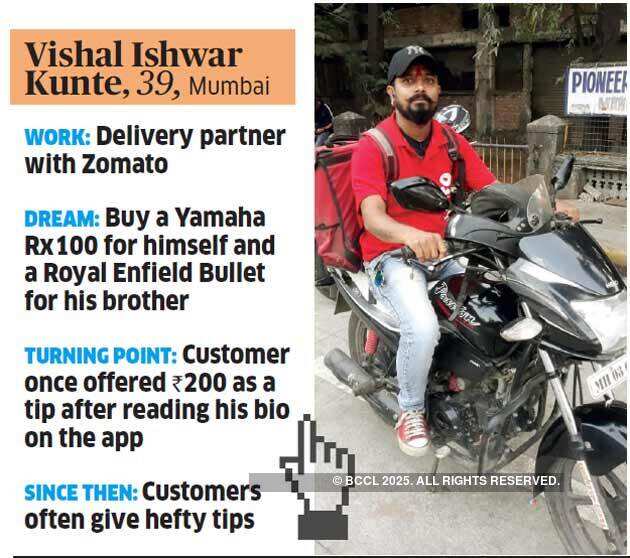
Even Vishal Ishwar Kunte, a Zomato rider from Mumbai’s Andheri East belt, tells ET Magazine that customers have started generously tipping him since the bio addition on the app. Kunte’s bio says the 38-year-old wishes to buy his dream bike someday. A few months ago, it piqued a customer’s curiosity.
“He addressed me by my name and invited me inside his house, offered me water and asked about the bike dream.
Kunte told him how he used to have a Yamaha Rx100 back in college when he lived with his family in hometown Pune. He mentioned the family had to relocate to Mumbai for his father’s cancer treatment at which point he had to sell that bike for money. On hearing the story behind his dream bike, the customer offered Kunte `200 as a tip. “I told him it was too much and if he really wants, he can give `20. But he said he wanted to contribute to my bike fund. A few weeks later, another customer gave me `100 cash as a tip,” says Kunte who does door-to-door and building-to-building food delivery for 13 hours every day.
Talking to the gig economy workforce is a lesson in privilege, says Karthik Rao, a 31-year-old e-sports professional from Bengaluru.
“It gives you the opportunity to learn about their struggles and get inspired by their story,” he adds.
Lalitha Bhagavathy from Chennai has still not thrown away an Amazon delivery carton she received three weeks ago, simply because it tells an inspiring story. The story of a lady seller, Rani Ravindran, who started her journey of selling art and craft products from a small town in Tamil Nadu called Periyakulam.
“I showed it to my kids so that they know how all this works, that there are people who work behind the scene for all the stuff that comes to us,” says the 38-year-old digital marketing professional. Amazon is in the process of bringing more such seller stories out—there are six circulating on delivery cartons at present.
Since the rollout of the first set of Storyboxes around Diwali 2019, the six sellers with transformative tales have seen popularity and sales gallop.
Vijaya Rajan, 46, who sells premium food products under the brand name Sirimiri through the marketplace, has seen her monthly sales double post the festive season.
“Thanks to the Storybox, the customers know that I created these products for my son’s nutritional requirements first. Concerned parents call me every day asking for advice now,” she says.
Be that as it may, “the humanisation of the gig economy is a business move, a way for companies to make you feel they’re more CSR-minded,” says anthropologist Sapru.
However, the few people who get noticed in the process, cherish it, she adds.
Take Kolkata’s very own Swiggy boy for instance.
When customers get the delivery partner’s details, they call him to check if he is indeed the same Milan Sinha from TikTok. On confirming, they add another dish to their order. “When I deliver both, they say the second one is for me,” he says.
Even an ace content creator like Sinha knows you can’t make this stuff up.