 By Naman VijayIndia’s retail market is estimated to be worth $600 billion. Today ecommerce comprises only 5% of the total. Compare that to the 15% stake e-commerce has in the US market, and it becomes clear there’s still plenty of room for growth. Despite efforts like ‘Digital India’, affordability of smartphones and data packages, vast sections of India’s population have yet to come online.India’s total internet user base is set to grow from 665 million in 2019 to 829 million by 2021. So, the inherent potential of the market is undeniable. And, yet, ecommerce remains highly underpenetrated with only 50 million online shoppers, of whom only 20 million are active monthly purchasers.This gap is indicative of the need to tackle a concern if India is to maintain its role as a global ecommerce lynchpin. For this, the corporate sector must join hands with GoI to ensure that transitions occur seamlessly and with minimal disruption. To that end, a holistic ecommerce framework needs to be established, one that incorporates best governance practices while catering to the unique needs of this vast new consumer base. Arobust physical and digital infrastructure must be implemented, one capable of handling the immense load placed upon it daily.Equally important are efforts to promote a shift to a digital economy. While GoI has taken a valuable first step through the implementation of the Unified Payments Interface (UPI) system, further efforts are needed via the expansion of formal banking and easy credit facilities for the citizenry. These efforts can be complemented by increased government support for ‘Make in India’ initiatives, particularly through the establishment of industrial corridors, logistics parks and special economic zones (SEZ).This can further be enhanced by the promotion of robust data protection frameworks along the lines of EU’s General Data Protection Regulation (GDPR), levelling the playing field between offline and online players in terms of indirect taxation, and easing restrictions on cross-border ecommerce transactions.Catering to the demands of an entirely different set of internet users demands adifferent approach. These future consumers are set to emerge from India’s tier-2 and tier-3 cities.The key challenges to overcome here are a diverse array of languages, an unfamiliarity with digital systems, and preferences for an eclectic array of products across micromarkets. All these factors demand the implementation of an appropriate omni-channel strategy. By combining this with a robust offline-to-online model, assisted sales and product curation, these new entrants to the ecommerce market can look forward to a smooth integration into the wider ecommerce ecosystem.Today, 70% of ecommerce customers are men with an average age of 25. But these figures are set to drastically change. Women are set to claim an equal share in the market, while the average age is expected to rise to 28 years. Also, as people become more accustomed to shopping online, the ordering of basic necessities will outpace discretionary purchases, leading to smaller overall ticket sizes. To keep up with these changing demands, it is crucial that the logistics sector, currently disorganised and fragmented, be efficient.The primary reasons for India’s underperformance are market inefficiencies and underdevelopment. This is most prominently manifested in return to origin (RTO) rates across India, especially when cash on delivery (COD) orders are involved. At present, COD rates are almost 90% in tier-3 and tier-4 cities, as compared to 50% in metros.However, RTO rates are practically doubled in these same cities. These numbers are indicative of the efficiency gap in the Indian logistics industry, especially in the hinterlands, and serve as a stark warning for the future. If not addressed now, India will find itself caught between a rapidly growing demand for logistics and a fragmented logistics ecosystem.The introduction of new-age logistics partners, and the advent of technologies such as artificial intelligence (AI) and machine learning (ML), offers a solution to these issues, allowing ecommerce companies to reduce RTO rates and confidently serve customers across the country.Much of this challenge has also been taken up by a select group of startups, all of whom are applying myriad technologies to optimise the efficient functioning of the system. In recent years, these efforts have started to bear fruit, resulting in venture capital firms committing their money and trust to these pioneers.In the past five months of 2019, the logistics sector has already witnessed a capital infusion of $6.25 billion. That’s more than a six-fold increase from the amount it raised in the preceding year. However, to tackle the many issues facing the sector, a collaborative partnership is required between all stakeholders involved: governmental, corporate, individual. It is only then that India’s full potential as an ecommerce destination will be achieved.
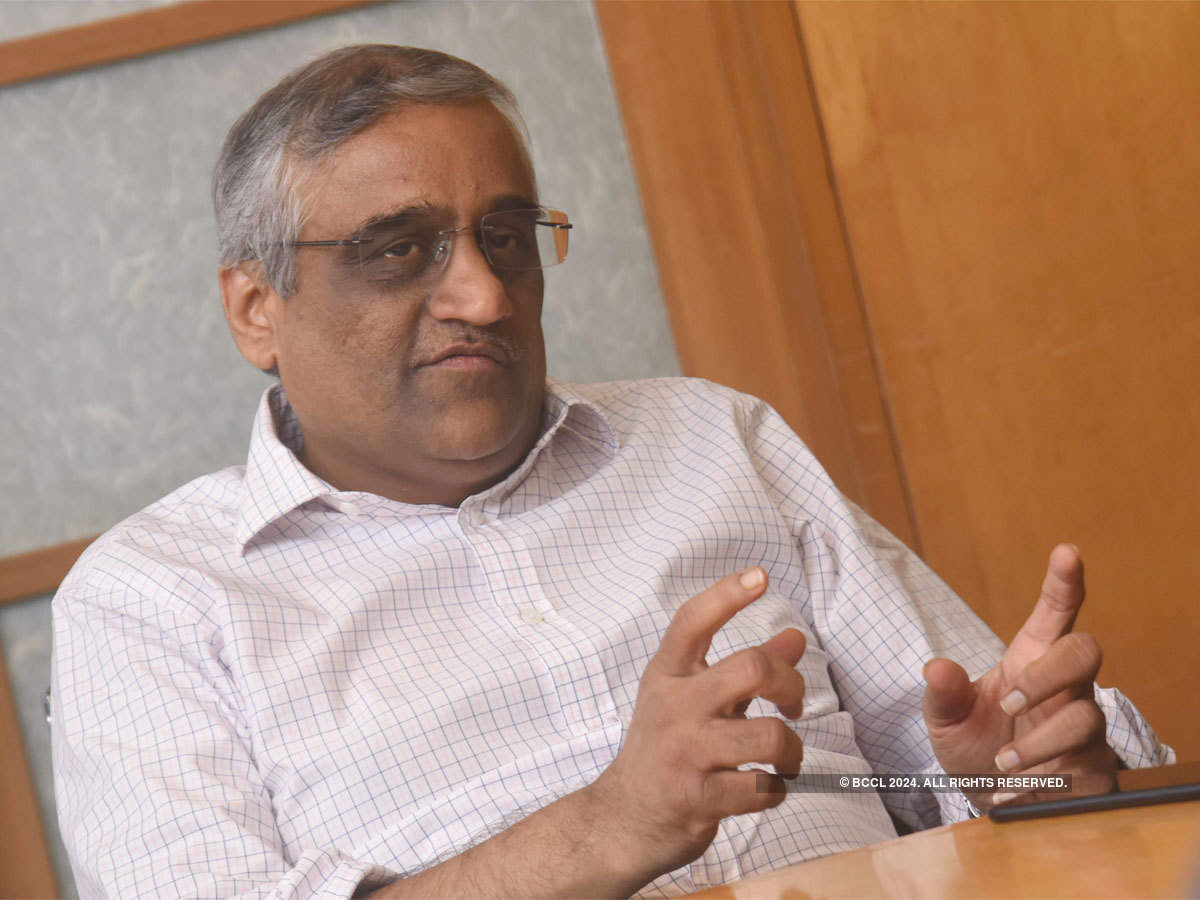 NEW DELHI: Future Group’s ‘Sabse Saste Din’ sale, centred around Republic Day, will also feature on Amazon.in, reflecting a broadening of the alliance between the two sides, said two persons with knowledge of the matter. Items are offered at a discount during the sale that runs for five-six days at Future Group stores such as Big Bazaar and Food Bazaar. Amazon acquired a stake in Kishore Biyani’s retail venture last year.The sale will operate through a web store on Amazon’s marketplace. The Future Group will deliver products ordered on the web store through its network of outlets and warehouses.“All Future Group big properties (discount events) will also be celebrated on Amazon,” said one of the persons. “This is the first time ‘Sabse Saste’ sales will happen outside of Future Group’s stable,” said the second person.Amazon and Future Group didn’t respond to queries.The Future Group already sells its private brands and other products ranging from food and fashion to furniture on Amazon.The marketplace also has an arrangement with Big Bazaar outlets for pickup and delivery of groceries to consumers purchasing through online supermarket Amazon Pantry.
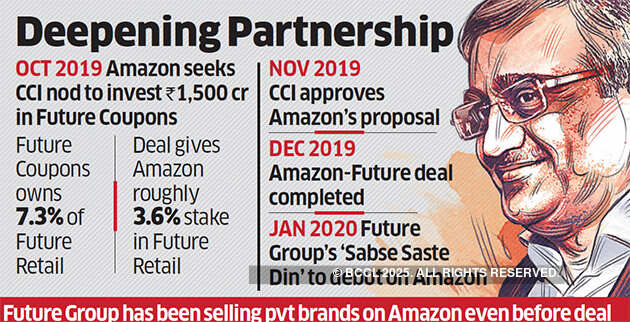 The ‘Sabse Saste Din’ sales are the biggest discounting event for the Future Group, generating millions of footfalls at its stores nationwide. However, it’s been on the wane in recent years due to the rapid growth of ecommerce platforms such as Flipkart and Amazon that offer discount sales through the year besides similar campaigns by other brick-andmortar stores.Last year, Amazon agreed to acquire a 49% stake in Biyani’s Future Coupons, which owns 7.3% of Future Retail, with an option to buy the entire holding at a later stage. This gives the US ecommerce titan roughly 3.6% stake in India’s largest listed retail entity and Biyani’s flagship venture, Future Retail.In November, Amazon.com NV Investment Holdings LLC received approval from the Competition Commission of India (CCI) to invest about Rs 1,500 crore to acquire the 49% stake in Future Coupons.The ‘Sabse Saste’ initiative on Amazon is part of a wide range of joint programmes that both are planning, according to the persons. Biyani told ET last month that his group expects $1 billion of incremental revenue from its association with Amazon in the next two-three years.“The Amazon partnership that rolls out now will build upon this in gaining new business and customers without additional costs or capex,” Biyani had said. “We believe we can create around a billion dollars of additional new business from the Amazon partnership alone in the next 24-36 months.”Amazon plans to tap Future’s vast network of physical stores to expand hyperlocal platform Amazon Now into newer cities, ET reported in December. The two sides are also exploring the possibility of allowing Amazon Prime members and digital wallet Future Pay customers to avail of common benefits and privileges.
 New Delhi, The Indian e-commerce market is expected to reach $200 billion by 2026 from the current $48.5 billion (as of 2018) and to create a level-playing field for small and medium players, the government brought in a new e-commerce policy and fresh rules around FDI in the sector in February this year that forced online marketplaces like Amazon India to change its ownership pattern in local partners like Cloudtail and Appario Retail.However, this has not stopped anti-market "predatory pricing" and "deep discounting" practices as violations of the e-commerce norms continued during the year, especially in the festive season, allege traders' bodies who intensified the protest against deep discounts and disruptive offers by e-commerce majors Amazon and Flipkart by organising a day-long hunger strike in several parts of the country on December 27."We want Indian e-commerce market free from all glitches, unhealthy and unfair business practices, and till the government takes any action, our national agitation will continue," said Praveen Khandelwal, Secretary General of the Confederation of All India Traders (CAIT).In order to comply with stringent e-commerce regulations, Amazon.com has already sold much of its stake in its desi partner Cloudtail, a joint venture between the Jeff Bezos' behemoth and software major Infosys founder N.R. Narayana Murthy's Catamaran Ventures.Amazon sold 25 per cent of its shares to Prione Business Services Pvt, a company run by Catamaran.According to media reports, Prione now owns 76 per cent of the venture and the remaining 24 per cent is reportedly owned by Amazon Asia-Pacific Resources Ltd, a non-Indian arm of the US retailer. Thus, Cloudtail technically is no more an Amazon company and is eligible to sell on the marketplace.Catamaran is now being headed by ex-Infosys CFO Ranganath Mavinakere, Murthy's all-time favourite.On the other hand, Appario Retail is a wholly-owned subsidiary of the joint venture between Amazon India Ltd and Ashok Patni, the co-founder of Patni Computer Systems.But it is Cloudtail that is profit-making venture for Amazon in the country, fulfilling over 25 per cent of all Amazon India orders.Cloudtail India reported a revenue growth of 25 per cent to Rs 8,945 crore in the previous financial year.According to media reports, while Amazon has over four lakh registered sellers, Cloudtail and Appario alone account for around 50 per cent of the sales.Walmart-owned Flipkart has not been impacted much as it has significantly reduced its dependency on vendors.According to Prabhu Ram, Head, Industry Intelligence Group (IIG), CMR, "The beneficiaries of the new e-commerce policy would potentially be small and bespoke e-commerce players, who could benefit from the level-playing field that the policy aims to provide."However, according to the traders' body, the online platforms are indulging in preferential seller system and more than 80 per cent of their sales are made by just their 10-15 preferred sellers.In a recent letter written to Prime Minister Narendra Modi, CAIT said the anti-market practices followed by the e-commerce players have created an uneven playing field, unfair and unethical competition, thus destabilising the overall retail trade.Amazon India, however, discarded the allegations of deep discounting and predatory pricing."Amazon is a 100 per cent pure marketplace in India. Sellers set the prices on their own. We do not interfere there at all," Gopal Pillai, Vice President, Seller Services, Amazon India, told IANS in an interview earlier this month.Following the complaints, the Department for Promotion of Industry and Internal Trade (DPIIT) sent a questionnaire to Amazon and Flipkart over their adherence to the FDI norms.The All India Online Vendors Association (AIOVA) has also filed a petition with anti-trust regulator the Competition Commission of India (CCI), alleging that the Amazon India favours merchants that are its subsidiary, such as Cloudtail and Appario.AIOVA, which represents more than 3,500 online sellers, reportedly said that large sellers such as Cloudtail and Appario are being given preferential treatment by charging significantly less than Amazon's advertised rates for other sellers.Earlier this month, the government made it mandatory for e-commerce firms to submit FDI policy compliance report by statutory auditor by September 30 every year.The e-commerce companies have to obtain statutory auditor report by September-end for the preceding financial year, the government said in a notification, hoping that the move will help ensure compliance of the FDI policy in the e-commerce sector in 2020.
 An industry desperately looking for clarity. India’s ecommerce industry, estimated to be worth over $ 50 billion, remains enmeshed in regulatory flux. With the final word yet to be said on the National Ecommerce Policy, separate guidelines have been drafted by different ministries on issues such as consumer protection and data privacy confounding an industry in search of regulatory clarity.Hopes of a stable policy framework had gained ground in June, when commerce minister Piyush Goyal said India would have a comprehensive ecommerce policy within a year.This followed months of upheaval triggered by new rules specifying that FDI-funded marketplaces could only lend their platforms to third-party sellers and barred such entities from holding any stocks or selling their own goods directly to customers. Morgan Stanley estimated the regulations would drive up business costs and uncertainty, including for industry leaders Amazon and Walmart-owned Flipkart. So much so, that its estimate of when India’s ecommerce would touch $200 billion was pushed forward by a year to 2027.Now, as Ministry for Electronics, Telecom and IT drafts rules that will govern non-personal data, and norms for consumer protection are drawn up by a separate ministry, online commerce could be left to battle on multiple fronts.
