Tuesday, 29 October 2019

Amazon India's e-commerce arm narrows FY19 loss to ₹5,685 cr

New Delhi: Amazon Seller Services, the online marketplace arm of the e-commerce giant in India, has narrowed its loss to ₹5,685 crore for 2018-19.
This is a 9.5 per cent decrease from the last financial year, when the company had posted a loss of ₹6,287.9 crore, as per documents sourced by business intelligence platform Tofler.
Amazon Seller Services saw revenues growing 55 per cent to ₹7,778 crore in 2018-19 over the previous fiscal, it added.
Coupled with its other entities in India, Amazon's losses in India in FY2018-19 were over ₹7,000 crore.
Amazon Wholesale India - the B2B arm of the American e-commerce giant - reported its revenues for financial year 2018-19 as ₹11,250 crore, an 8 per cent fall since the last financial year.
The entity's loss, however, widened to about ₹141 crore during the same fiscal, from ₹131.4 crore in 2017-18.
Amazon Pay India - its payments arm that competes with the likes of Paytm, Flipkart's PhonePe and Google Pay - recorded a manifold rise in losses. Its loss widened to ₹1,160.8 crore in FY19 from ₹334.20 crore in FY18, as per Tofler.
The unit's revenues for financial year 2018-19 more than doubled to ₹834.5 crore over the previous fiscal.
Amazon Transportation Services reported 31 per cent rise in revenues at ₹2,079 crore, while its net loss was at ₹27.5 crore in 2018-19.
Emails sent to Amazon India did not elicit a response.
Amazon and its rival, Walmart-owned Flipkart have been pumping in millions of dollars across various operations like marketplace, infrastructure and supply chain management as well as marketing and promotion.
Amazon founder Jeff Bezos had committed investment worth USD 5 billion in the Indian market in 2016.

Saturday, 26 October 2019

Early Diwali may hit Amazon’s Q4 growth

Bengaluru: Amazon’s international sales growth rate might be impacted in the final quarter of this financial year as parts of Diwali sale happened in the third quarter this year. The festive sale had taken place in the fourth quarter last year, said Amazon CFO Brian Olsavsky. He was speaking to analysts after the announcement of its September quarter earnings.

The e-tailing major’s losses from international business, which counts India as a critical market, remained flat at $386 million (Rs 2,735 crore) for the quarter ended September 2019 compared to $385 million (Rs 2,728 crore) a year ago. On a sequential basis, the Seattle-based company had clocked losses of $601 million (Rs 4,258 crore) in this business for the quarter ended June this year.

“The Diwali holiday was all in the fourth quarter last year and a bit of it was in third quarter this year,” Olsavsky said, citing it as one of the reasons for his outlook on the final quarter. He mentioned Japan raising consumption tax was another reason for the outlook.

“So, if you wrap those together, we expect it’s going to be more of an issue with our international growth rate,” he added. Olsavsky added he was looking forward to the fourth quarter when holiday sales will start in the US. It has estimated a cost of $1.5 billion for faster shipping, largely for its one-day delivery, to consumers during this season in the US.

Amazon, which is finishing its last leg of the festive sale in India, has been under the scrutiny of the government along with rival Walmart. Commerce minister Piyush Goyal recently said his ministry was probing the role of Walmart (via Flipkart) and Amazon in predatory pricing affecting small traders in the offline market. These companies have been sent a detailed questionnaire on the issue too.

Both Amazon and Walmart maintain they are compliant with local laws.

Globally, Amazon saw sales of $70 billion during the quarter under review, a jump of 24%. Its profits stood at $2.1 billion for the third quarter compared to $2.9 billion in the same period last year. This is the first time Amazon has recorded a lower profit on a year-on-year basis since the second quarter of 2017.

Cheaper mobile data is fuelling growth of etailers in non-metros

E-commerce might appear to be a two-horse race but scratch the surface and it’s teeming with other etailers that are reporting brisk business. In fact, this festive season is proving to be great for off-the-radar e-commerce companies. These are the ones that are more conscious of profitable growth and keen to get new and repeat buyers – mostly away from the big metros.

“It’s been a fairy tale,” says Ambareesh Murty, cofounder of Pepperfry, a furniture e-tailer that claims sales are up 50% from a year earlier. Comeback kid Snapdeal has witnessed 52% growth in demand this Diwali, driven largely by shoppers from non-metros.

“Snapdeal’s business volumes have more than doubled in 120 non-metro cities including Satara, Anand, Pali, Roorkee, Jhansi, Haridwar, Tezpur and Hassan,” a company spokesperson said. Nine of 10 orders on Snapdeal were from non-metros.

KGanesh, serial entrepreneur and partner of Growthstory.in, a platform for startups, says the number of consumers has grown and its portfolio companies BigBasket and BlueStone have seen a 70-80% increase in transactions. Online jewellery e-tailer BlueStone says the spend per order per year has increased to Rs 50,000 to Rs 60,000 now from Rs 20,000 to Rs 40,000 over the past few years.

Chinese e-tailer Club Factory has seen a faster growth rate in tier 2 & 3 cities in West Bengal, Bihar and Telangana.

“Net increase in metro cities remains strong as people are more familiar with online shopping. Mobile phones, accessories, electronics and lifestyle items are seeing brisk sales,” says Vincent Lou, CEO of Club Factory.

Curated marketplace Qtrove, which sells non-GMO products, jewellery e-tailer Bluestone and even lingerie e-seller Clovia have seen sales increase this festive season.
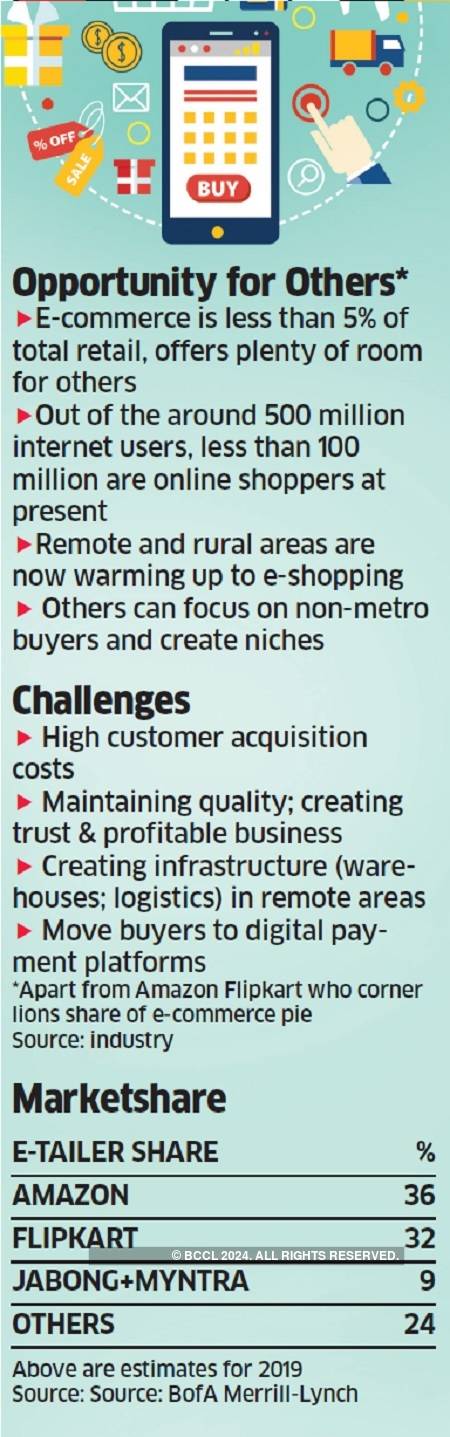
Cheaper mobile data is fuelling growth of etailers in non-metros
“Thanks to Jio, the market has expanded,” says Pankaj Vermani, CEO of Clovia, referring to the cheap data plans offered by telco Reliance Jio Infocomm. “Our average ticket size has gone up by 10% and this time we have seen a rise in demand for nightwear and high-end lingerie with a higher consumption in tier 2, 3 towns like Saharanpur and Meerut.”

Cheaper data plans have contributed to expanding mobile internet and getting more e-shoppers on board. According to the Snapdeal spokesperson, only 100 million of India's 440 million internet users have shopped online. However, the market is now expanding beyond the first 100 million e-commerce buyers.

“The trends we have seen from Diwali sales are an unequivocal confirmation that e-commerce is now a strong channel for buyers in smaller cities,” he added.

Snapdeal has noticed growth in the middle and lower ends of the market as more value-conscious customers came in.

“Unbranded merchandise from bazaars has started to move online to cater to this demand,” the spokesperson added.

At Pepperfry, its omnichannel strategy – it has 65 stores where people can see, experience and buy online – paid off and sales are up 50% from last season. The company is also looking at raising $20 million and going public in 2020.

A noticeable difference this time was the rise of the first time, nonmetro, online shopper who’s actually buying from her smartphone. According to Snapdeal, first-time users surged across cities such as Nashik, Surat, Chandigarh, Panaji and Guwahati and the overall growth in first-time users was 2.3 times year-on-year.

Ganesh of Growthstory attributed the surge in the tier 2 and 3 e-shopper to better internet services and almost free bandwidth, vernacular language enablement by e-commerce companies, ease of payments like scan and pay, and overall lower levels of penetration of e-commerce in smaller towns.

According to Harsha Razdan, partner and head for consumer markets, retail and internet business at KPMG India, “Regional localisation and fulfilment centres and festive season offers, catering particularly to regional customers, have helped.”

Razdan said the rural population, which makes up 60% of the country’s population, is yet to be tapped to its full potential.

“Tier 2 and 3 towns and rural areas will become the next battleground of growth for e-commerce companies,” he said.

The growth of smaller e-commerce companies during this festive season has shown that while the top two may have cornered the lion’s share of business, there is still potential for growth – less than 5% of retail is online – and there’s room for many more platforms.

However, the smaller companies still need sort out a few things. According to Razdan, these include product range, quality and trust, supply chain costs, and the cost of customer acquisition.


Meesho revenue at Rs 84 cr

Meesho revenue at Rs 84 crBENGALURU: Social commerce startup Meesho reported revenue of Rs 84 crore for the financial year ended March 31, up from Rs 6 crore in the corresponding period last year.

Losses widened to Rs 100.42 crore from Rs 5 crore in the previous financial year, according to regulatory filings.

Meesho enables small businesses and individuals to start online stores via social channels such as WhatsApp, Facebook and Instagram.

The firm offers solutions for discovery, logistics and payments to enable easier transactions between resellers and buyers. The category is, however, plagued with high return rates of as much as 40-50%.

A large part of the company’s expenses went towards employee salaries, logistics, marketing and reseller bonus, discounts, rewards and reimbursement.

In August, the company raised $125 million, led by Naspers, with participation from US technology company Facebook and existing investors SAIF Partners, Sequoia Capital, Shunwei Capital, RPS and Venture Highway.

Visa to enable OTP-less e-shopping

Visa to enable OTP-less e-shoppingMumbai: Visa cardholders will soon be able to complete payments on select e-commerce sites without having to wait for an one-time password (OTP).

The payments company will activate ‘Visa Safe Click’ (VSC) across leading online merchants for transactions below Rs 2,000 in value.

VSC is a lightweight, secure software plug-in for mobile app-based e-commerce merchants. For transactions up to Rs 2,000, shoppers don’t need an OTP as the solution uses cryptographic validation along with Visa’s global risk engine to authenticate each transaction.

The RBI had relaxed norms for transactions below Rs 2,000 in 2016, allowing the payment networks to do the second factor authentication without using OTP. VSC is designed as a frictionless payment solution for e-commerce, which is built exclusively for the Indian market.

VSC will be launched this festive season across leading e-commerce merchants to provide consumers a secure and seamless payment experience. Flipkart is understood to be one of the early adopters. In a transaction with OTP, the customers is taken out of the e-commerce website to a payment gateway to complete the transaction.

This adds two more legs to the transaction and increases the chances of a failure particularly when traffic is high.

“The Indian e-commerce market is expected to reach US$1.2 trillion by 2021. However, digital payment success rates are trending below 80%, resulting in suboptimal consumer experience and a significant revenue loss for the e-commerce industry. E-commerce merchants are grappling with an ever-growing number of consumer issues such as cart abandonment, connectivity and incorrect passwords during the payment leg of their transaction,” said T R Ramachandran, group country manager, Visa (India and south Asia), said.